



Key Takeaways
- HIPAA sets national standards to protect electronic protected health information (ePHI).
- Emails containing PHI and protected by HIPAA email encryption remain secure during transmission by preventing unauthorized access.
- HIPAA mandates that organizations use secure and appropriate encryption for PHI; HHS and NIST guidelines recommend modern protocols such as TLS 1.2+.
Few industries hold information as sensitive as the healthcare industry. A single patient record can contain personally identifiable information, medical histories, insurance details, and even financial data—all of which make healthcare organizations a prime target for cybercriminals.
To safeguard this kind of information, the U.S. established the Health Insurance Portability and Accountability Act (HIPAA). HIPAA establishes national standards for protecting health data, requiring healthcare providers, insurers, and their business associates to implement robust safeguards for privacy and security. Among its many requirements, HIPAA emphasizes the importance of securing digital communications, including email, which remains one of the most common entry points for attacks.
Through HIPAA email encryption, healthcare organizations aim to guarantee that sensitive data remains unreadable to unauthorized parties, reducing the risk of breaches while maintaining compliance.
What Is HIPAA Email Encryption?
HIPAA compliant email encryption is a security solution that takes readable protected health information (PHI) and transforms it into unreadable text, ensuring that only the intended recipients are able to read the original information. At the same time, it keeps confidential information about patients, such as their medical records and their treatment plans and billing, from being intercepted while it’s transmitted.
The HIPAA Security Rule requires covered entities to implement safeguards that protect electronic PHI (ePHI). While encryption isn’t explicitly required, it’s listed as an “addressable” implementation specification under § 164.312(a)(2)(iv) and § 164.312(e)(2)(ii). This means organizations must either:
- Implement encryption for data in transit and at rest, or
- Document a risk assessment showing why alternative measures provide equivalent protection.
Encryption works in two main contexts:
- In transit: Protects emails as they travel between servers and recipients.
- At rest: Secures stored messages on servers, devices, or backup systems.
For most healthcare organizations, encrypting email in transit is non-negotiable. Without it, PHI is vulnerable to man-in-the-middle attacks, unauthorized access, and regulatory penalties.
Why HIPAA Email Encryption Matters
Unsecured emails that include PHI expose healthcare organizations to great danger and related risk. Those risks are associated mainly with the categories below:
Legal and Financial Penalties
HIPAA violations can result in fines ranging from $100 to $50,000 per violation, with annual maximums reaching $1.5 million per violation category. Even a single unsecured email can trigger an investigation and enforcement action.
Trust and Reputation
Patients entrust health care professionals with the highest level of privacy. A breach, especially one that includes unencrypted email, undermines that trust and can result in the loss of patients, media backlash against your company and long-term damage to your brand.
Protection Against Cyber Threats
Phishing emails, business email compromise (BEC), and spoofing campaigns often target healthcare organizations. Email encryption protects against these threats by ensuring that even if an email is intercepted, the PHI remains unreadable.
HIPAA Email Encryption Requirements
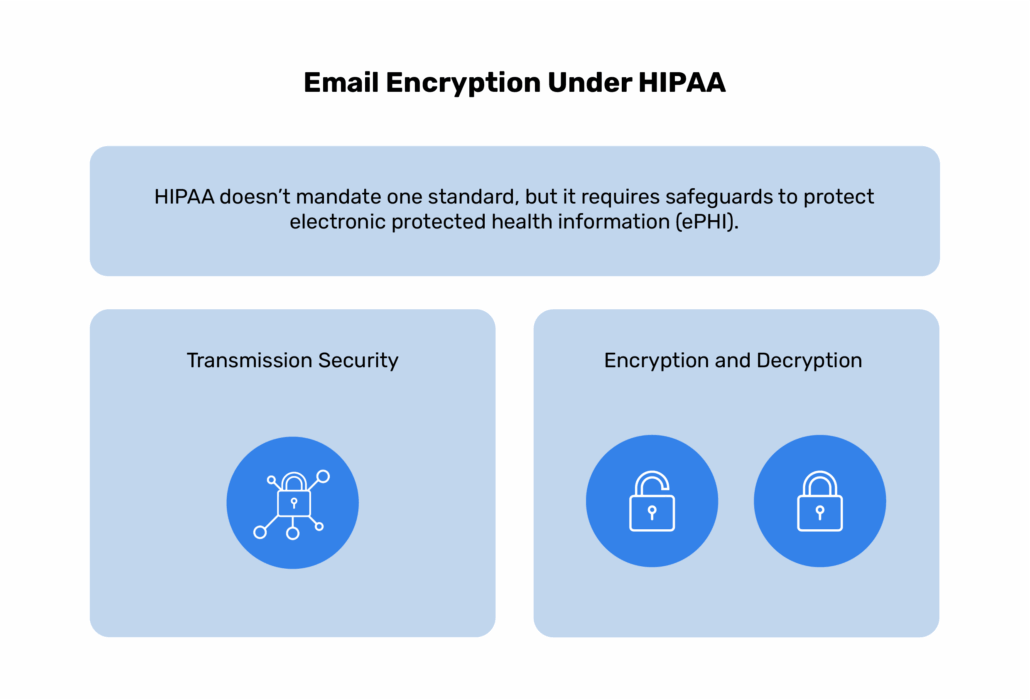

HIPAA does not mandate a single encryption standard, but it does define when and how encryption should be applied to protect electronic protected health information (ePHI).
The Security Rule’s technical safeguards (§ 164.312) emphasize two key areas:
- Transmission Security (§ 164.312(e)(1)): Organizations must implement measures to prevent unauthorized access to ePHI during transmission over electronic networks.
- Encryption and Decryption (§ 164.312(e)(2)(ii)): This is listed as an “addressable” requirement, meaning encryption mechanisms—or equally effective alternatives—must be in place to secure data at rest and in transit.
In practice, this means encryption is expected in situations such as:
- Sending PHI via email to external recipients like patients, providers, or business associates.
- Transmitting PHI over unsecured networks.
- Cases where alternative safeguards (such as secure patient portals) are not practical.
Even when not strictly required, encryption is strongly recommended in scenarios such as internal emails containing PHI, communications with business associates, and any instance where there’s a risk of unauthorized exposure.
Today, it is good practice for covered entities and business associates to follow current National Institute of Standards and Technology (NIST) guidance like Special Publication 800-45 (Version 2), which outlines standards for securing email systems consistent with HIPAA.
Types of Email Encryption for HIPAA Compliance
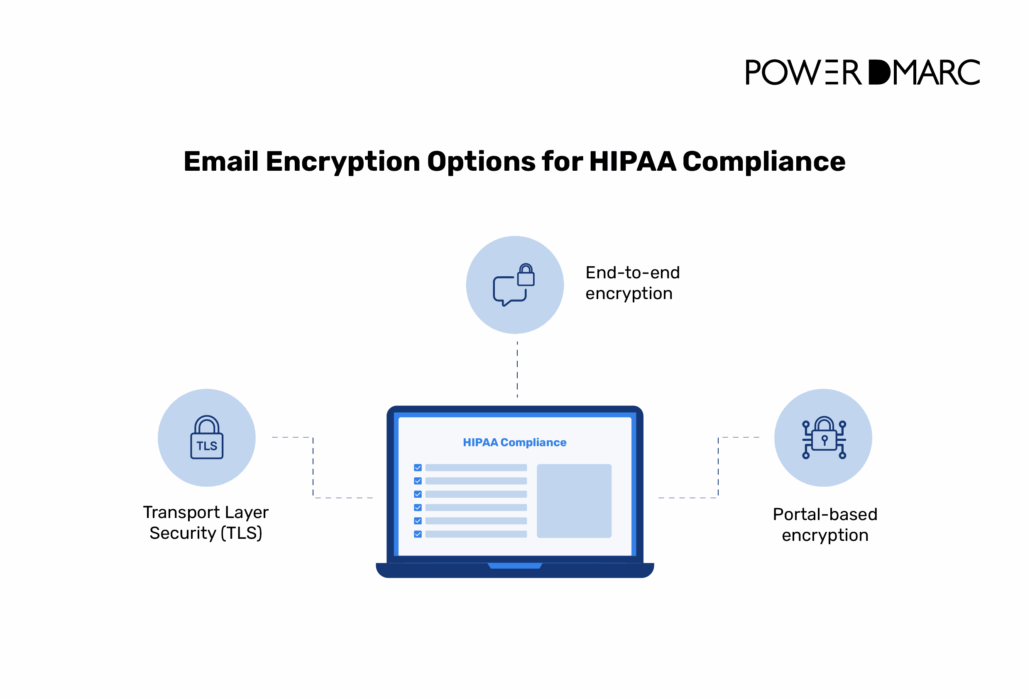
Choosing the right encryption method depends on your organization’s technical capabilities, user experience priorities, and compliance needs. Below are the three primary options:
Transport Layer Security (TLS)
Transport Layer Security (TLS) encrypts email while it is in transit between mail servers. It is widely supported, transparent to users, and HIPAA-compliant when both the sender and recipient servers support TLS 1.2 or higher.
The main advantage of TLS is that it provides a seamless user experience since messages are sent and received without extra steps, while still protecting against interception during transmission.
The downside is that it’s not end-to-end, so messages could still be saved in plaintext on servers. It also only works when both sides support TLS and, if the recipient’s server doesn’t, the email may be sent in plain text. For these reasons, TLS is best suited for day-to-day message exchanges between providers when two servers are each compatible with more recent TLS versions.
End-to-end encryption
With end-to-end encryption (E2EE) only the sender and recipient see the message. Even if the email is intercepted, from transport or server storage it remains encrypted and unreadable.
The advantage of E2EE is its high level of security, which protects PHI not only from external interception but also from insider threats or server breaches.
The drawback is that it requires recipients to have compatible tools or keys, which can create complexity. It may also reduce convenience because of additional steps, such as exchanging public keys.
E2EE, with its ironclad privacy protection, is suggested for extremely sensitive topics such as psychiatric records or legal disclosures. It complies with HIPAA, only the sender and receiver can see the contents.
Portal-based encryption
Portal-based encryption, on the other hand, sends an email containing a secure link to a web portal rather than the PHI itself. Patients and providers log into the website using HTTPS to view or download messages encrypted with a public key.
The benefit of this approach is that it doesn’t require recipients to have any special software and powers organizations with control over access, through features such as expiration dates and audit logs.
The drawback is that it requires extra steps for users, who must log in to retrieve their messages, and it also depends on maintaining the portal infrastructure and user education. Portal-based encryption is often used for patient-facing communication where ease of access and regulatory compliance must be carefully balanced.
Best Practices for HIPAA Email Encryption
Implementing encryption is just the first step in fulfilling the standards set by HIPAA. To maintain compliance and security, it’s also important to employ these practices:
For healthcare organizations
Healthcare providers are on the front lines of PHI protection, and consistent practices are essential to reduce risks.
- Train staff on encryption policies: Employees need to know when and how to use encryption tools. Ongoing training helps prevent accidental PHI exposure.
- Implement strong access controls and authentication: Multi-factor authentication (MFA) ensures that only authorized users can access encrypted emails and PHI systems.
- Use audit trails and monitoring: Tracking who sent what, when, and to whom allows organizations to detect suspicious activity and provide proof of compliance during audits.
- Regularly test and update encryption systems: As cyber threats evolve, organizations must routinely test their encryption protocols, patch vulnerabilities, and keep software up to date.
- Choose HIPAA-compliant email vendors: Work only with providers that offer Business Associate Agreements (BAAs), support modern encryption standards like TLS 1.2 or higher, and maintain audit-ready logs.
For business associates
Business associates who handle PHI on behalf of healthcare organizations share equal responsibility for keeping it secure.
- Ensure BAAs include encryption requirements: Contracts with covered entities must clearly outline encryption obligations and compliance responsibilities.
- Encrypt all PHI transmitted on behalf of providers: Even if you are not the primary custodian of PHI, you are still responsible for protecting it during transmission.
- Maintain compliance records for audits: Document encryption practices, risk assessments, and incident response logs to demonstrate compliance and due diligence.
- Provide secure patient communications: When communicating directly with patients, always use encrypted channels such as portals, end-to-end encryption, or TLS-enabled email.
- Stay updated on regulatory changes: HIPAA guidelines evolve, so subscribing to updates from the HHS Office for Civil Rights (OCR) helps ensure that policies remain aligned with current requirements.
How to Choose a HIPAA Compliant Email Encryption Solution
Selecting the right HIPAA-compliant email encryption solution requires striking the right balance between security, usability, and compliance. Alongside email controls, regulated providers often rely on healthcare-grade cloud infrastructure to host ePHI under BAAs and audit-ready safeguards. The most effective tools safeguard PHI while also fitting well into daily operations so that staff can work efficiently without sacrificing protection.
When considering a product, you want to consider the following core features:
- TLS 1.2 or higher for secure in-transit encryption
- End-to-end encryption for communications involving highly sensitive PHI
- Business Associate Agreements (BAAs) to define vendor responsibilities
- Audit logs and reporting to track usage and support compliance audits
- Integration with IT systems such as EHR or practice management software
In addition to technical specifications, usability is often the deciding factor in whether an encryption solution succeeds. A tool that requires minimal training will encourage consistent adoption, while scalability ensures it can grow alongside your organization.
It is also important to ensure the vendor offers ongoing support, updates, and patches on a recurring basis in order to succeed over the long term. An effective encryption solution should be flexible and strong enough to secure patient data.
Conclusion
HIPAA email encryption is fundamental for safeguarding patient privacy, ensuring regulatory compliance, and defending against cyber threats. By training staff, choosing compliant vendors, and continuously monitoring email security, you can protect PHI, avoid costly violations, and build patient trust.
For all those seeking to secure their domains and ensure HIPAA compliance, PowerDMARC offers managed DMARC services that simplify email authentication and encryption, protect your organization from phishing, spoofing, and compliance risks. So, start your free trial today and secure your domain in minutes.
Frequently Asked Questions
Is HIPAA email encryption mandatory for all healthcare emails?
Not explicitly, but encryption is an “addressable” safeguard under HIPAA—required when you can’t ensure recipient security or when emailing PHI externally.
What is the difference between HIPAA secure email and HIPAA encrypted email?
“Secure email” is a broad term that may include access controls, authentication, and audit trails; “encrypted email” specifically refers to encoding PHI so only authorized parties can read it—encryption is the technical mechanism ensuring security.



- Email Security Predictions for 2026: What Companies Need to Prepare For - December 3, 2025
- Email Health Check: What It Means and How to Run It - November 26, 2025
- Best Email Deliverability Tools: Improve Inbox Placement - November 18, 2025