


Key Takeaways
- AI phishing uses machine learning and automation to create highly personalized, error-free attacks that are harder to detect than traditional phishing attempts.
- Deepfake audio and video technology enables attackers to impersonate trusted individuals convincingly, making voice and video verification unreliable.
- Email authentication protocols like DMARC, combined with AI-powered detection tools and ongoing user training, provide the strongest defense against evolving AI phishing threats.
Phishing has been the most common form of cybercrime for years, with an estimated 160 billion spam emails sent every day worldwide. Now, artificial intelligence is transforming these attacks from easily spotted scams into sophisticated threats that even security-conscious professionals struggle to identify.
AI-driven phishing is the newer, more advanced form of email attacks. It uses machine learning to study huge amounts of data, write convincing messages, create fake media, and run large, automated campaigns with ease. Tasks that used to take attackers a lot of time (researching targets, writing believable messages, and personalizing them) can now be done in seconds with AI tools.
The FBI’s Internet Crime Complaint Center received 321,136 phishing and spoofing complaints in 2024, making it one of the most frequently reported internet crime categories. As AI capabilities expand, these numbers are expected to rise significantly.
It’s now crucial for both organizations and individuals to understand how AI is changing phishing attacks and how to defend against them.
What Is AI Phishing?
AI phishing uses artificial intelligence to create, personalize, and send highly convincing malicious messages. Unlike traditional phishing that relies on generic templates and obvious errors, AI phishing produces contextually appropriate, grammatically perfect content tailored to specific targets.
These attacks combine natural language processing (NLP), data mining, and automation to analyze publicly available information about targets (social media profiles, professional networks, news articles, and corporate websites), then generate highly personalized messages that exploit that knowledge. The result is phishing message content that appears legitimate, relevant, and urgent.
AI phishing operates across multiple channels, including email, SMS (smishing), social media, messaging platforms, and voice calls (vishing), but email security is the critical first line of defense against these threats.
What makes AI phishing particularly dangerous is its ability to bypass traditional detection methods. Where older email phishing indicators like spelling errors, awkward phrasing, and generic greetings once helped users identify threats, AI-generated content eliminates these red flags. Modern AI phishing emails can match or exceed the quality of legitimate business communications.
The technology behind AI phishing isn’t new or particularly expensive, as many of the same tools used for legitimate marketing, customer service, and content creation can be repurposed for malicious purposes. This easy access has made it much easier for cybercriminals to get involved, allowing even inexperienced attackers to run polished, professional-looking phishing campaigns.
How AI Enables More Sophisticated Attacks
Modern AI phishing relies on analyzing huge amounts of data to understand targets, generating natural and human-like language, creating deepfake media, and running fully automated campaigns. These technologies make attacks faster, more convincing, and much harder to detect than traditional phishing.
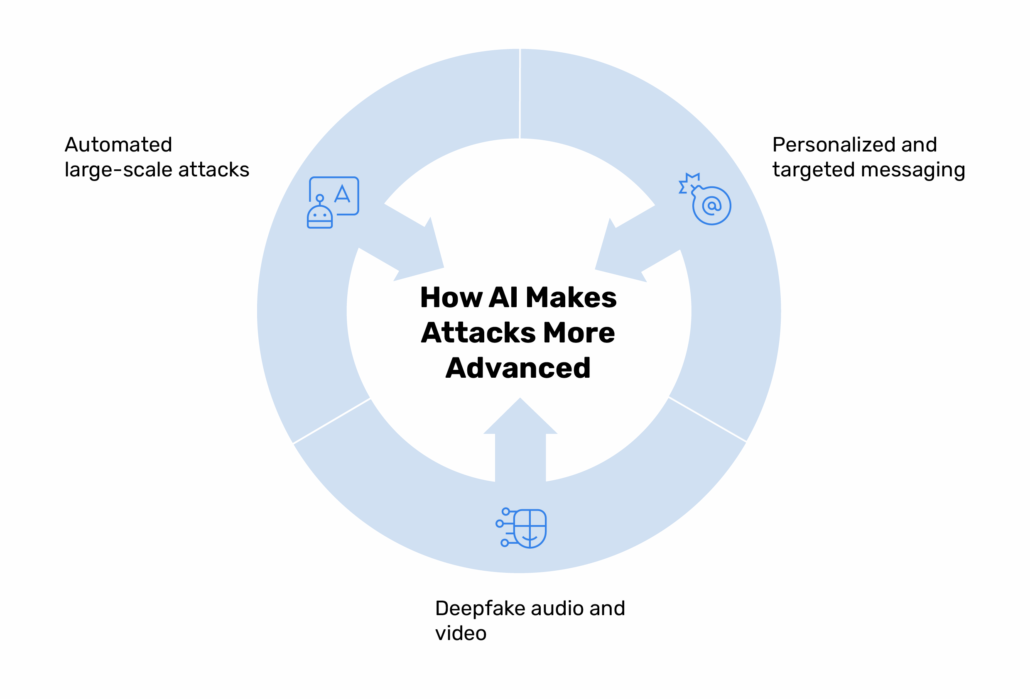

Personalized and targeted messaging
AI excels at gathering and analyzing public information to create highly targeted spear phishing attacks. By scraping social media profiles, professional networks like LinkedIn, corporate websites, and news articles, AI tools build detailed profiles of potential victims, including their roles, relationships, interests, communication patterns, and current projects.
With this information, attackers can create messages that mention real coworkers, current projects, or recent events, which makes the phishing attempt feel believable and relevant. For example, an AI system might notice that a CFO recently posted about attending a specific conference, then generate a phishing email impersonating a vendor they met there, referencing specific sessions and conversations that make the message seem authentic.
The personalization extends beyond surface-level details. AI analyzes writing style, vocabulary, and communication patterns to match the expected tone and format of legitimate messages. If a target typically receives formal, detailed emails from their accounting department, the AI phishing attempt will mirror that style. If they’re accustomed to brief, casual messages from their manager, the attack adapts accordingly.
Deepfake audio and video
Voice cloning and video synthesis technologies have advanced dramatically, enabling attackers to create convincing audio and video content that impersonates trusted individuals.
These deepfakes can be generated from relatively small amounts of source material, sometimes just minutes of publicly available audio or video, making executives, public figures, and anyone with an online presence vulnerable.
Common scenarios where deepfake technology is weaponized include:
- Executive impersonation: Attackers create synthetic audio of a CEO or CFO requesting urgent wire transfers or sensitive information.
- Vendor verification calls: Fake AI-generated voices can mimic suppliers or partners to approve fake invoices or request changes to payment details.
- Emergency scenarios: Synthetic voices claiming to be family members or colleagues in crisis situations, demanding immediate financial assistance.
- Video conference infiltration: Deepfake video used in virtual meetings to impersonate participants and provide fraudulent approvals.
Automated large-scale attacks
AI greatly cuts down the time and effort needed to run phishing campaigns. Where traditional attackers might send hundreds of messages per day, AI-powered systems can generate and distribute millions of unique, personalized phishing attempts in the same timeframe. Google blocks nearly 10 million spam emails every minute, and AI automation is expected to increase these volumes significantly.
The automation extends across the entire attack lifecycle:
- Target identification: AI scans public data sources to identify high-value targets and potential entry points.
- Content generation: Natural language models create unique messages for each recipient, eliminating template-based detection.
- Timing optimization: Machine learning determines the optimal send times based on target behavior patterns and time zones.
- Response handling: Chatbots interact with victims who respond, maintaining the deception and guiding them toward credential theft or malware installation.
- Campaign refinement: AI analyzes success rates and automatically adjusts tactics to improve future attempts.
This kind of automation lets attackers operate on a huge scale, testing thousands of message variations at once and quickly adjusting to defenses. Traditional security tools that depend on fixed signatures struggle to keep up with AI-generated content that changes constantly.
Common Examples of AI Phishing
AI phishing manifests across multiple attack vectors, each exploiting different vulnerabilities in human psychology and technical systems. Understanding these common techniques helps organizations build appropriate defenses.
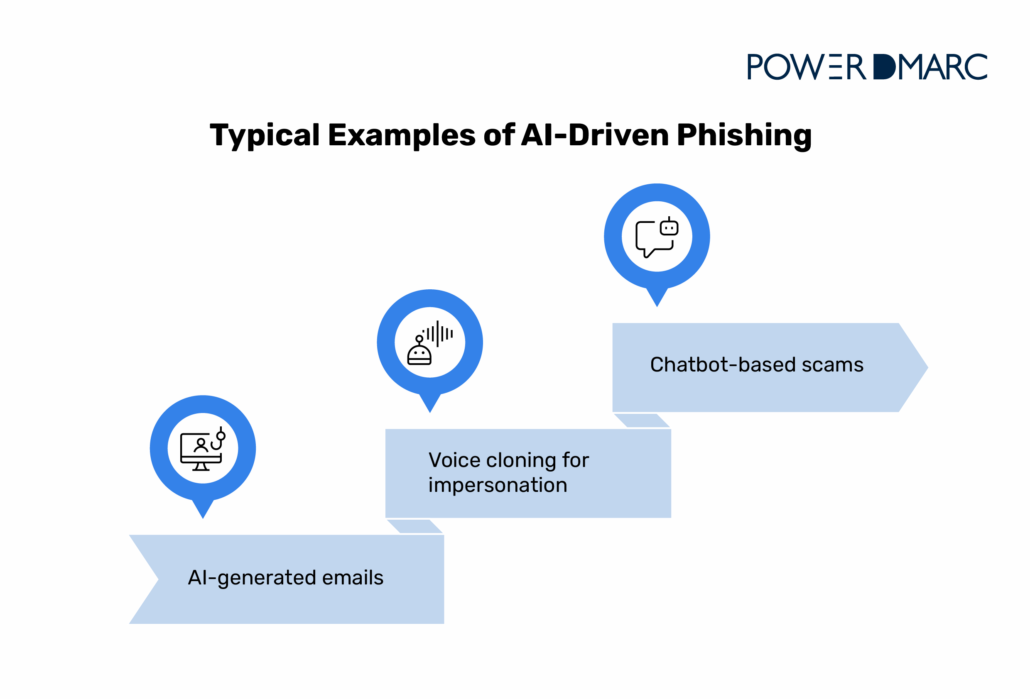
AI-generated emails
Email remains the primary delivery channel for phishing attacks. AI-generated phishing emails eliminate the grammatical errors and awkward phrasing that traditionally helped users identify malicious messages.
Modern AI tools produce emails that are:
- Contextually appropriate: Messages reference real events, projects, or relationships relevant to the target.
- Professionally formatted: Layout, signatures, and branding match legitimate corporate communications.
- Urgency-driven: Content creates pressure to act quickly without verification, exploiting psychological triggers.
- Error-free: Grammar, spelling, and syntax are flawless, removing traditional red flags.
AI-generated phishing emails often impersonate industry phishing patterns, following sector-specific communication norms to appear more legitimate. For example, AI-generated phishing targeting healthcare organizations might reference HIPAA compliance or patient data regulations, while attacks on financial institutions might mention transaction verification or regulatory audits.
Voice cloning for impersonation
Voice synthesis technology has reached the point where synthetic voices are nearly indistinguishable from genuine recordings. Attackers can clone voices from publicly available sources, such as earnings calls, conference presentations, podcasts, or social media videos, then use the synthetic voice to impersonate executives, family members, or trusted colleagues.
High-risk situations where voice cloning is especially dangerous include:
- Business email compromise (BEC) follow-ups: After sending a fraudulent email requesting a wire transfer, attackers call using a cloned executive voice to “verify” the request.
- Emergency fund requests: Synthetic voices impersonate family members claiming to be in accidents, arrests, or medical emergencies requiring immediate payment.
- IT security verification: Fake help desk calls using cloned voices of IT staff to request credentials or system access.
- Vendor payment changes: Impersonating known suppliers to change payment routing information.
The effectiveness of voice cloning attacks stems from our psychological trust in auditory verification. When an email seems suspicious, many people call to verify. But if the attacker anticipates this and provides a callback number that reaches an accomplice or automated system using cloned voice, the verification process actually reinforces the scam rather than exposing it.
Chatbot-based scams
Malicious chatbots built with large language models can hold long, convincing conversations with victims. They can slowly gather sensitive information while pretending to offer real customer service or tech support. These AI-driven bots can:
- Impersonate customer support: Appearing in search results or social media as “official” help channels, then stealing credentials or payment information.
- Conduct social engineering: Building rapport over multiple interactions to gain trust before making fraudulent requests.
- Bypass verification questions: Using AI to generate plausible answers to security questions based on publicly available information.
- Scale interactions: Simultaneously engaging thousands of victims with personalized responses.
The difficulty of distinguishing malicious chatbots from legitimate customer service tools creates significant risk. A study of phishing in higher education found that more than a quarter of students opened phishing emails, and about half of those who opened them clicked the links, demonstrating how even educated, security-aware users fall victim to convincing interactions.
How to Protect Against AI Phishing
Defending against AI phishing requires a layered approach combining technical controls, defensive AI tools, and ongoing user education. No single solution provides complete protection, so organizations must implement multiple overlapping defenses to detect and prevent these sophisticated attacks.
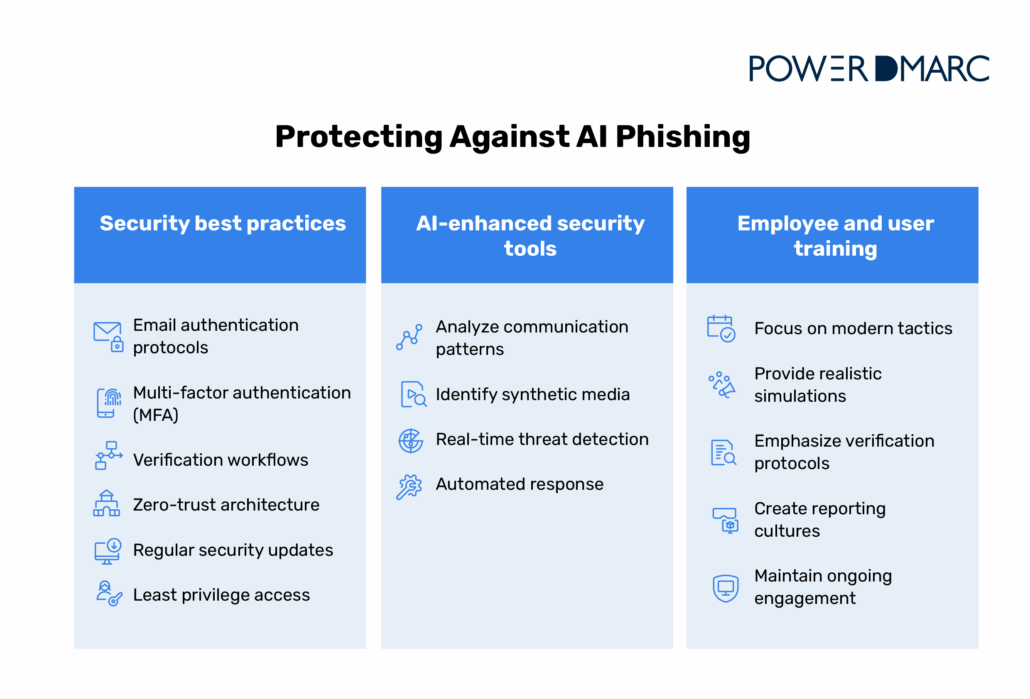
Security best practices
Fundamental security practices remain critical even as attacks become more sophisticated. Organizations should prioritize:
- Email authentication protocols: Implement SPF, DKIM, and DMARC to prevent domain spoofing and verify sender identity. PowerDMARC provides automated setup and monitoring to make authentication accessible for organizations of any size.
- Multi-factor authentication (MFA): Require MFA for all accounts, especially those with financial or administrative privileges. Even if credentials are stolen through phishing, MFA provides an additional barrier.
- Verification workflows: Establish clear procedures for verifying high-risk requests, like wire transfers, credential changes, or sensitive data access, through independent channels, not by replying to suspicious emails or using provided contact information.
- Zero-trust architecture: Implement zero-trust security models that verify every access request regardless of source, limiting lateral movement if attackers gain initial access.
- Regular security updates: Keep operating systems, applications, and security software current to close known vulnerabilities that phishing attacks might exploit after initial compromise.
- Least privilege access: Limit user permissions to only what’s necessary for their roles, reducing the potential damage from compromised accounts.
IBM reported that data breaches cost organizations an average of about $4.4 million per incident in 2025, making investment in comprehensive security controls financially justifiable.
AI-enhanced security tools
Traditional email security must be augmented with DMARC and AI-powered detection to counter AI-driven phishing and Business Email Compromise. Defensive AI tools can:
- Analyze communication patterns: Detect anomalies in sender behavior, message content, or request patterns that indicate potential phishing.
- Identify synthetic media: Use machine learning to detect deepfake audio and video through subtle artifacts and inconsistencies.
- Real-time threat detection: Continuously monitor email traffic, identifying suspicious links, attachments, or domains before messages reach users.
- Automated response: Quarantine suspicious messages, alert security teams, and prevent credential theft in real time.
PowerDMARC’s platform supports zero-trust email security by enforcing DMARC policies and verifying sender identity, helping organizations block spoofed emails before they reach inboxes. Organizations can save up to about $300,000 per year by implementing DMARC to reduce spoofing and phishing losses.
The main strength of AI-powered security is its ability to spot new, unfamiliar attacks. While signature-based tools miss constantly changing AI-generated messages, defensive AI studies new threats and adapts continuously.
Employee and user training
Technology alone cannot prevent all phishing attacks, so human judgment remains a critical defense layer. However, only 13% of targeted employees report phishing attempts, limiting organizations’ ability to respond to intrusions and warn others.
Effective security awareness programs should:
- Focus on modern tactics: Update training beyond traditional phishing indicators to address AI-generated content, deepfakes, and sophisticated social engineering.
- Provide realistic simulations: Use simulated phishing campaigns that reflect current threat techniques, measuring user response and providing immediate feedback.
- Emphasize verification protocols: Train employees to verify unusual requests through independent channels, especially for financial transactions or credential changes.
- Create reporting cultures: Make reporting suspicious messages easy and encourage employees to report without fear of embarrassment or blame.
- Maintain ongoing engagement: Conduct regular training updates as threats evolve; security awareness is a continuous process.
The Future of AI in Cybersecurity
The cybersecurity AI race is speeding up. Attackers and defenders are both using advanced machine learning, and as AI phishing tools become easier to use and more powerful, defensive systems must evolve just as quickly.
Expected developments in AI-driven security include:
- Behavioral biometrics: Systems that verify identity based on typing patterns, mouse movements, and other behavioral characteristics difficult for AI to replicate.
- Real-time deepfake detection: Advanced algorithms that analyze audio and video in real time during calls and conferences, alerting participants to synthetic media.
- Predictive threat intelligence: AI systems that anticipate emerging attack patterns based on dark-web activity, vulnerability disclosures, and attacker behavior.
- Automated incident response: Machine learning that detects, isolates, and remediates phishing attacks without human intervention, reducing response times from hours to seconds.
- Personalized security controls: Adaptive systems that adjust security requirements based on risk context, such as location, device, behavior patterns, and request sensitivity.
As AI makes attacks more convincing and scalable, defenders must implement comprehensive, multi-layered security programs that combine authentication, detection, response, and education. No single technology or approach provides complete protection against the evolving threat of AI phishing.
Organizations that understand the capabilities and limitations of both offensive and defensive AI, and invest in comprehensive security programs accordingly, will be best positioned to protect against famous phishing attacks and emerging threats in the years ahead.
The Bottom Line
AI phishing is a major shift in how cybercriminals operate. It brings a new level of scale, personalization, and sophistication that traditional security tools struggle to handle. AI-generated phishing is often more convincing than human-written messages, deepfake technology is spreading quickly, and organizations in every sector now face growing risks from these advanced attacks.
But defense is possible. Organizations that implement comprehensive security programs, combining email authentication protocols like DMARC, AI-powered detection tools, multi-factor authentication, and ongoing user training, can significantly reduce their exposure to AI phishing attacks. The key is recognizing that no single solution provides complete protection; effective defense requires multiple overlapping layers.
PowerDMARC offers a DMARC-based authentication platform combining SPF, DKIM, monitoring, and reporting to stop spoofing and phishing. Our tools make email authentication accessible for organizations of any size, helping you build a strong first line of defense against AI-driven threats.
If you’re ready to strengthen your email security against AI phishing, start by verifying your current authentication posture and identifying vulnerabilities before attackers exploit them. Strong email security begins with visibility and control, two things PowerDMARC delivers from day one.
Frequently Asked Questions (FAQs)
Is AI phishing more common on mobile devices or computers?
AI phishing targets both platforms equally, though mobile users may be more vulnerable due to smaller screens that hide sender details and fewer visual security cues.
What industries are most targeted by AI-powered phishing attacks?
Financial services, healthcare, technology, and government sectors face the highest targeting rates due to valuable data assets, though small businesses across all industries increasingly face AI phishing threats.


- What Is AI Phishing? A Guide to Emerging Cyber Threats - December 11, 2025
- Stop Spam Emails: Protect Your Sender Reputation - November 29, 2025
- ActiveCampaign DKIM, DMARC, and SPF Setup Guide - November 25, 2025