


Google and Yahoo have introduced a brand new set of email authentication requirements for bulk message senders. The requirements impact those who send > 5000 emails per day. To follow the new requirements, bulk senders need to deploy SPF, DKIM, and DMARC, enable easy unsubscription, and focus on message relevance.
Google has been the pioneer in encouraging, exercising, and enforcing stringent privacy policies. These policies ensure end-to-end protection of email transactions and communication. Google’s new email authentication policies aim to reduce email fraud and spam in 2024.
Google and Yahoo Bulk Senders Will Need DMARC
In their latest email guidelines, Google has enforced email authentication deployments starting in Feb 2024. Domain owners who send bulk messages to Gmail addresses would be required to authenticate their emails with DMARC.
As of November 2025, these requirements have been enforced, with Google stating that non-compliant emails will face temporary and permanent rejections.


Source: Google Support
Gmail’s AI-powered integrated defenses already stop spam, phishing, and other forms of email fraud by 99.9%. These systems restrict nearly 15 billion undesired emails daily. In 2024, Google plans to take it one step further by making it mandatory for more than 5000/day message senders to validate their emails.
Yahoo isn’t far behind either. Yahoo described that their key objective is to provide an optimal emailing experience for receivers. This objective will ensure you only receive messages that interest you.
To meet this objective, Yahoo’s email guidelines declared that in 2024 bulk message senders will need to deploy DMARC. Senders must also implement one-click unsubscription, and send emails that are of value to Yahoo users.
Google Email Authentication Requirements for Bulk Email Senders
If you send more than 5000 emails per day:
1. Authenticate Your Emails with SPF, DKIM, and DMARC
Google and Yahoo required all bulk senders to implement email authentication protocols SPF, DKIM, and DMARC. This stops threat actors from impersonating legitimate domain names to send spam messages.
Sender Policy Framework, or SPF, will allow bulk email senders to authorize legitimate senders. SPF allows only permitted domains and IPs to send emails on behalf of their domain – thereby reducing spam complaints.
DomainKeys Identified Mail (DKIM) helps protect your email’s content from being altered. It adds digital signatures to message headers as a verification mark.
DMARC binds it all together by aligning messages against SPF and/or DKIM checkpoints. With DMARC, you can set up instructions for receiving servers to accept, quarantine, or reject misaligned emails. It helps protect your domain against phishing, spoofing, business email compromise, and more.
2. Easy One-click Unsubscription
Email users should be able to unsubscribe from receiving emails from a particular sender with just one click! One-click unsubscribe mechanism is another bulk email requirement declared by Google and Yahoo. This will make it easier for receivers to opt out of receiving messages that do not interest them. It also helps maintain a spam-free inbox.
3. Stay Under the 0.3% Spam Rate Threshold
Google uses several technical measures to block out spam messages from reaching users. They are now enforcing a clear threshold for spam that needs to be maintained. Spam rate should ideally be below 0.1%. This will ensure that their receivers can further avoid receiving unwanted or malicious messages. By all means, the spam rate shouldn’t be equal to or exceed 0.3%.
Yahoo recommends keeping the spam rate below 0.3% as well.
Google Email Sender Requirements for all Senders
If you are not a bulk email sender, you still need to follow some email authentication best practices for Gmail. Google has been encouraging users to follow safe-sender practices for a long time, irrespective of whether they send bulk emails or not.
If you send less than 5000 emails per day:
- Email Senders must enable SPF or DKIM
Note: In general, DMARC requires either SPF or DKIM domains to align for compliance. However, Google particularly mentions both SPF and DKIM alignment for only bulk senders. Bulk-sending sources that have DMARC and SPF without DKIM, will still fail their requirements.
- Sending domains and IP addresses must have valid PTR records
- Your message’s spam rate must be below 0.3% (Google recommends using Google Postmaster tools for running your spam rate check)
- Your message format must follow IMF specifications as mentioned under RFC 5322
- Impersonating Gmail From: headers is not allowed and can reduce your mail delivery rates
- The domain in the sender’s “From:” header must match the domain in either the return-path header (for SPF) or the DKIM signature header
- Forwarded emails must be signed by ARC
Learn more about these requirements in Google’s document.
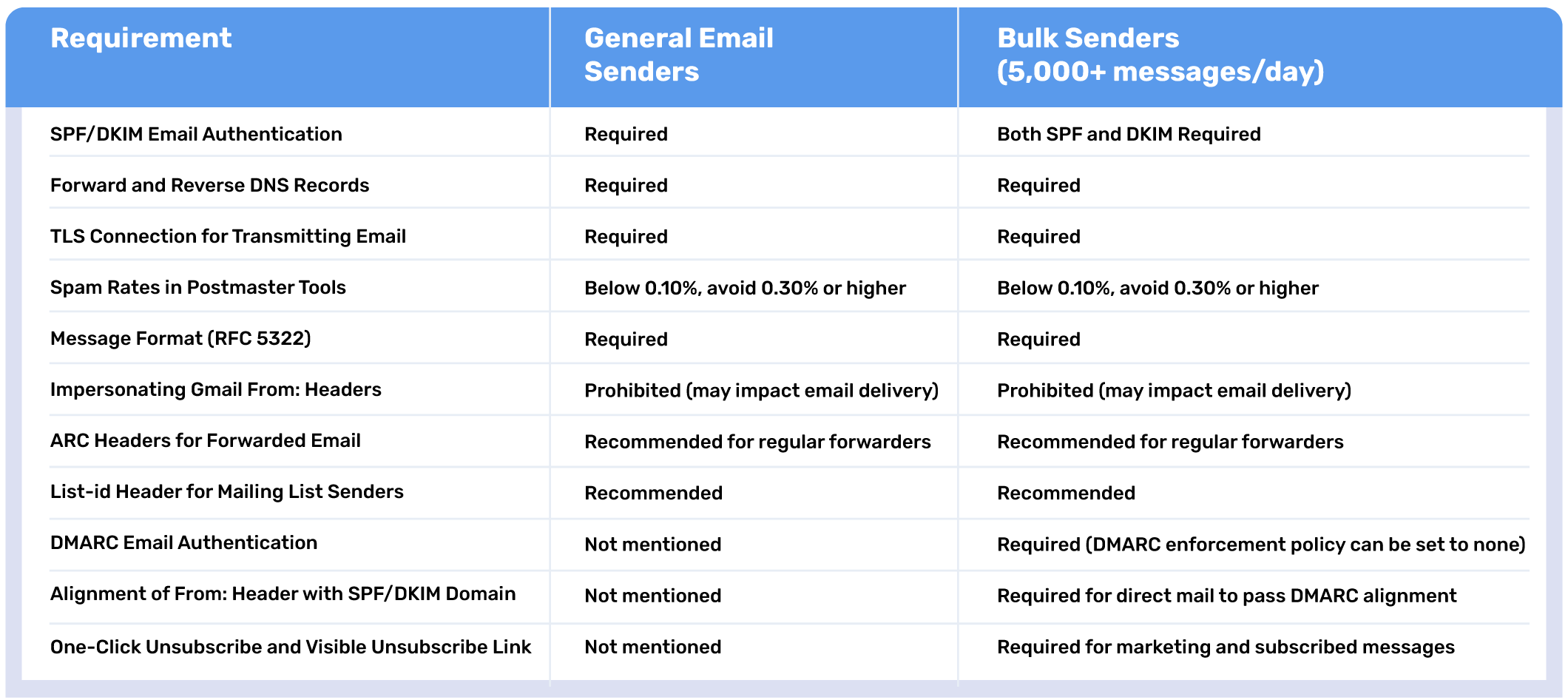
Gmail General Vs Bulk Email Sender Guidelines

Yahoo Email Sender Requirements for All Senders
General email senders for Yahoo must adhere to the following requirements:
- Senders must enable SPF or DKIM email authentication
- Keep spam rate below 0.3%
- Have a valid forward and reverse DNS record for your sending IPs
- Follow RFCs 5321 and 5322
Slowly Enforcing Email Sender Requirements Over Time
Yahoo and Google are making constant updates to their email authentication requirements. They are hinting at the fact that enforcement will be gradual but progressive. Here are the latest timelines for enforcement:
- Google started enforcing guidelines for bulk senders from February 2024. Non-compliant senders were expected to see temporary and sporadic delays in message delivery. With time, the delays may transform into outright rejections. The number of non-compliant emails will steadily increase. The deadline for the one-click unsubscription was extended to June 2024. From November 2025, Gmail tightened enforcement with non-compliant emails now facing temporary or even permanent rejections.
- Yahoo will enforce most of the guidelines and requirements, from February 2024. This includes email authentication (DMARC, SPF and DKIM) mandates. For one-click unsubscription feature, the deadline has been extended to June 2024.
Timelines and requirements may keep changing as Google and Yahoo add new mandates. They may even extend deadlines for enforcement to ensure no one is left out. This will ensure every sender maintains the highest standards of email sending practices. We will keep updating this blog for interested readers to return to from time to time and observe the latest updates!
PowerDMARC Helps You Meet the New Email Requirements
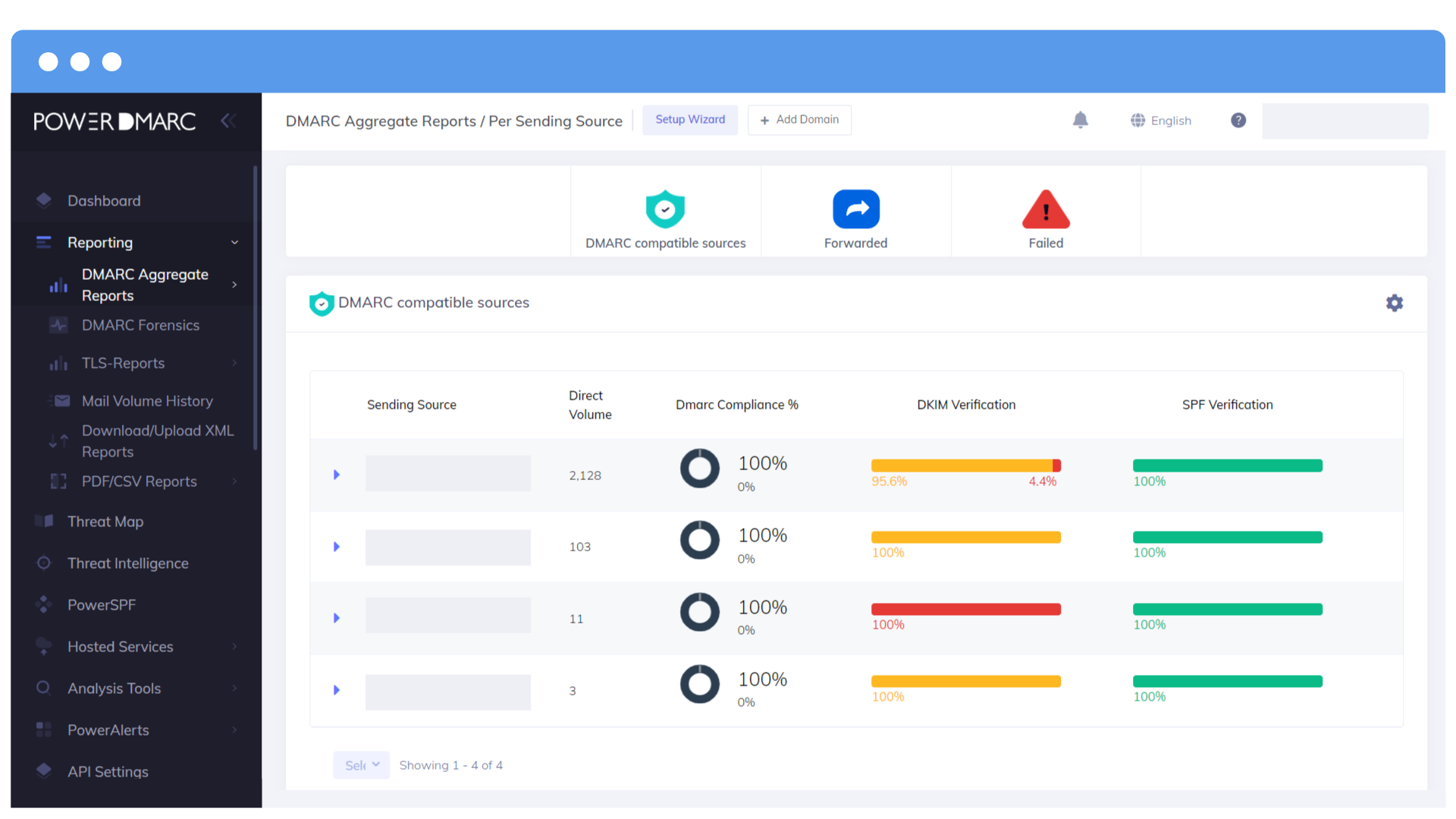

Enabling email authentication protocols requires strong technical knowledge and deep understanding. Things are easier with PowerDMARC. PowerDMARC is formed by a team of experts that help you activate DMARC, SPF, and DKIM easily. Our hosted services enable monitoring and reporting on a single cloud interface.
Our Google and Yahoo Compliance Program help you take simple and actionable steps:
- Understand email authentication and DMARC policies
- Set up DMARC, SPF, and DKIM
- Check the correctness of your setups with a single click
- Monitor your authentication results and deliverability
- Gain access to a range of other tools for advanced email protection
We also provide 24/7 assistance with a commitment toward customer satisfaction. Our one-on-one support ensures a smooth transition to enforced policies. This mitigates the risk of email deliverability issues. Contact us today to get started!
In addition to this, it is important to enable a one-click unsubscribe header. Keep your spam rate to a minimum as well. This will help you adhere to Google and Yahoo’s latest requirements in 2024.
Additional Questions
When do these new requirements come into action?
The new requirements for Google and Yahoo are set to come into action by 1st February 2024.
Whom do these new requirements impact?
Any email sender who sends more than 5,000 emails per day is subject to these latest requirements. However, Google’s general email sender requirements are applicable to all senders whether or not they send bulk messages on a regular basis.
What if I fail to fulfill the requirements?
Failing to fulfill Google and Yahoo’s email security requirements before 1st February 2024 will negatively impact your email’s deliverability rate. Your emails are more likely to end up in your recipient’s spam folder or get discarded outright by their mail server.



- PowerDMARC Recognized as Leader in DMARC Software for Winter 2025 - December 4, 2025
- LaunDroMARC: How a Microsoft SRS Loophole Is Laundering Spoofed Emails - December 4, 2025
- Top 7 Best Email Verification Tools for Secure Delivery - November 28, 2025