Best DMARC AI Tools in 2026: Which Providers Actually Use AI (and How)

by
Last Updated:
9 min read

by
Last Updated:
Key Takeaways
Scan the marketing pages of almost any DMARC vendor today and you will find the phrase “AI-powered” attached to something: threat intelligence, reporting, monitoring, or enforcement. The trouble is that the phrase means very different things from one provider to the next. In some cases it points to a specific, documented feature you can actually use. In others it is closer to a marketing adjective sitting on top of the same rule-based automation the tool has always had.
This roundup tries to separate the two. Rather than repeat each vendor’s own language, it looks at what each provider’s AI feature actually does, and flags where a claim is vendor-stated versus independently checkable.
If you are new to the protocol itself, PowerDMARC’s What is DMARC guide is a good starting point, and its DMARC AI and the Evolution of Email Authentication piece covers the broader background on how AI is being applied here.
We researched and evaluated top DMARC providers in the market offering AI capabilities in their feature stack, and here’s the honest breakdow:
G2 rating: 4.9 out of 5
Best for: Teams that want AI assistance built directly into a full-stack DMARC, SPF, DKIM, and BIMI platform, rather than a separate bolt-on product.
PowerDMARC is an email authentication and domain security platform that has the most specifically documented AI functionality found in this research, and it comes in two distinct parts: a conversational DMARC AI Agent built into the dashboard, and a separate layer of AI-driven threat intelligence. It is worth keeping both of these separate from PowerDMARC’s MCP server, which allows external AI tools such as Claude, ChatGPT, or Cursor to query your live account data from outside the platform.
AI capabilities:
G2 rating: 4.8 out of 5 (listed on G2 under its operating company, Kevlarr)
Best for: MSPs specifically looking for a dedicated, AI-automation-first product rather than a broader full-stack platform that happens to include AI features.
DMARC.ai is operated by Kevlarr, which was founded in 2019 and began as a product initiative aimed at securing email for small and medium businesses before expanding toward managed service providers. Its whole positioning is built around AI-driven automation for MSPs deploying DMARC, SPF, DKIM, and BIMI across many client domains.
AI capabilities:

G2 rating: 4.8 out of 5
Best for: Enterprise teams that want an embedded AI assistant tied to a mature, API-first DMARC platform with strong threat intelligence.
Red Sift is an established email and domain security company whose OnDMARC product is a mature, API-first platform used across mid-market and enterprise organizations, and available through partnerships such as Cisco’s security portfolio. Its named AI feature is Red Sift Radar, an embedded large language model integrated into the DMARC workflow.
AI capabilities:
G2 rating: 4.9 out of 5
Best for: Organizations that value guided setup and managed support, with the caveat that a conversational AI assistant is not currently the platform’s headline capability.
Sendmarc is an email authentication platform focused on simplifying DMARC, SPF, and DKIM through guided workflows and managed support, serving mid-sized organizations, enterprises, and MSPs. Its emphasis is on guided setup and human-led support rather than a built-in conversational AI assistant, so its AI-related capabilities focus on automating the authentication workflow.
AI capabilities:
G2 rating: 4.6 out of 5
Best for: Larger organizations with complex, multi-provider email environments that want automated enforcement over ongoing manual DNS management.
Valimail is an established, enterprise-focused email authentication vendor and an early developer of automated DMARC. Its products, Authenticate and Enforce, are built around automatically discovering the services sending mail on your behalf and then guiding you to and through enforcement without manual DNS work. Its approach centers on automation and ongoing record maintenance rather than a conversational assistant or threat-detection feature.
AI capabilities:
G2 rating: New entrant with a limited public review count on G2;
Best for: IT, security, and marketing teams, or agencies managing multiple domains, that want clear, guidance-based monitoring without wading through raw reports.
DMARCeye is a standalone DMARC monitoring platform built by the engineering team behind the European email marketing company Ecomail, and tested at scale before its global release. Its focus is on turning raw DMARC XML into plain-language guidance for teams without specialist expertise, and it offers several AI-based features.
AI capabilities:
On top of our above list of best DMARC AI tools, the following platforms also include AI features worth noting:
DMARC Report markets AI-driven insight detection as part of its reporting, positioned as a step beyond basic report visualization. Its AI angle centers on surfacing notable findings from aggregate report data rather than a conversational assistant, so it is best thought of as automated analysis layered onto its enterprise DMARC reporting.

DMARCOFF includes an AI assistant called Luma, which analyzes DMARC reports and DNS authentication setup for a chosen period, flags issues such as misconfigurations, compliance drops, and unknown or suspicious sending sources, and returns step-by-step recommendations.
Luma is included with paid domain plans, with a set number of AI analysis credits per domain each month. DMARKOFF also runs an MCP server, which lets external AI assistants such as Claude and ChatGPT read live DMARC data, including Luma’s recommendations.

Zerobounce is an email deliverability platform that includes DMARC monitoring rather than a DMARC-first tool. Its AI is applied to deliverability rather than DMARC specifically: an email scorer that analyzes list-wide deliverability and suggests improvements, plus AI-driven catch-all scoring for individual addresses. Its DMARC monitoring itself is standard aggregate report parsing with alerts, not an AI feature.
Because the label is now nearly universal, a short checklist helps separate substance from marketing:
1. Is the feature named?
A vendor that points to a specific, named feature (an “AI Agent,” “Radar,” “AI Security Analysis”) is usually further along than one using “AI-powered” as a floating adjective.
2. Can you find it in the vendor’s own documentation?
If the only place a capability appears is a marketing page or a third-party review, and not in the product’s own docs or help center, be skeptical, especially if that review uses identical wording for several different vendors.
3. What manual task does it remove?
A real AI feature should replace something a human would otherwise do by hand, such as interpreting reports, flagging anomalies, or answering configuration questions. If it does not clearly do that, the “AI” may just be a label on standard rule-based automation.
If you want a broader platform comparison beyond the AI angle specifically, PowerDMARC’s Top DMARC Providers, Vendors and Solutions list and its platform comparison page are useful reference points.
“AI-powered” has recently become a standard marketing term among DMARC management platforms, which makes it less useful as a signal on its own. The substance behind the phrase differs, from a fully documented conversational agent that answers your configuration questions, to an embedded LLM, to automated record maintenance, to just a marketing label. The practical takeaway is simple: do not buy based on the label. Ask each vendor to name the feature, show you where it lives in their own product, and explain what manual work it takes off your plate.
To incorporate true AI-powered DMARC and authentication intelligence into your email security stack, sign up for a free trial with PowerDMARC today!
What does “AI-powered DMARC” actually mean?
While the meaning varies widely by vendor, AI-powered DMARC usually means a specific feature such as a conversational assistant that interprets DMARC reports and answers email auth configuration questions, or a model that scores sending IPs by behavior and flags anomalies. In some cases, it can be a marketing label attached to standard automation features.
What is PowerDMARC’s DMARC AI Agent?
PowerDMARC’s DMARC AI Agent is a conversational assistant built into the PowerDMARC platform, trained on PowerDMARC’s knowledge base and on the SPF, DKIM, and DMARC standards. It helps diagnose authentication failures, SPF and DKIM problems, and spam placement issues, so you can troubleshoot without deep DMARC expertise. PowerDMARC describes deeper, account-specific personalization as a planned future addition.
Is MCP the same thing as a DMARC AI Agent?
No. A DMARC AI Agent, like PowerDMARC’s, is a vendor’s own assistant that lives inside its dashboard. An MCP (Model Context Protocol) server is a connector that lets external AI tools such as Claude or ChatGPT query your DMARC data from outside the platform. They serve a similar goal of getting faster answers about your DMARC posture, but they are different products.







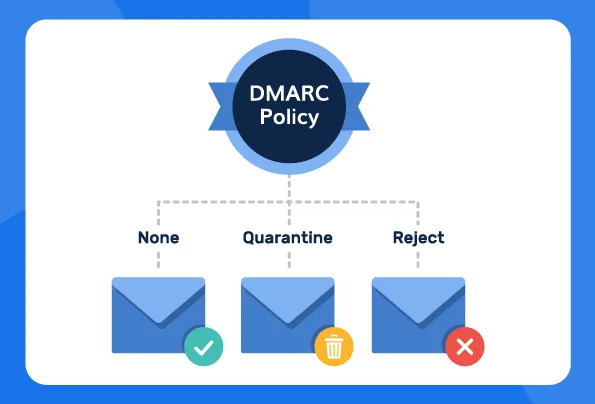 What is a DMARC Policy? None, Quarantine, and Reject