Automated SPF Management with Hosted SPF
0+
Organisations worldwide0+
Fortune 100 and governments0+
Countries served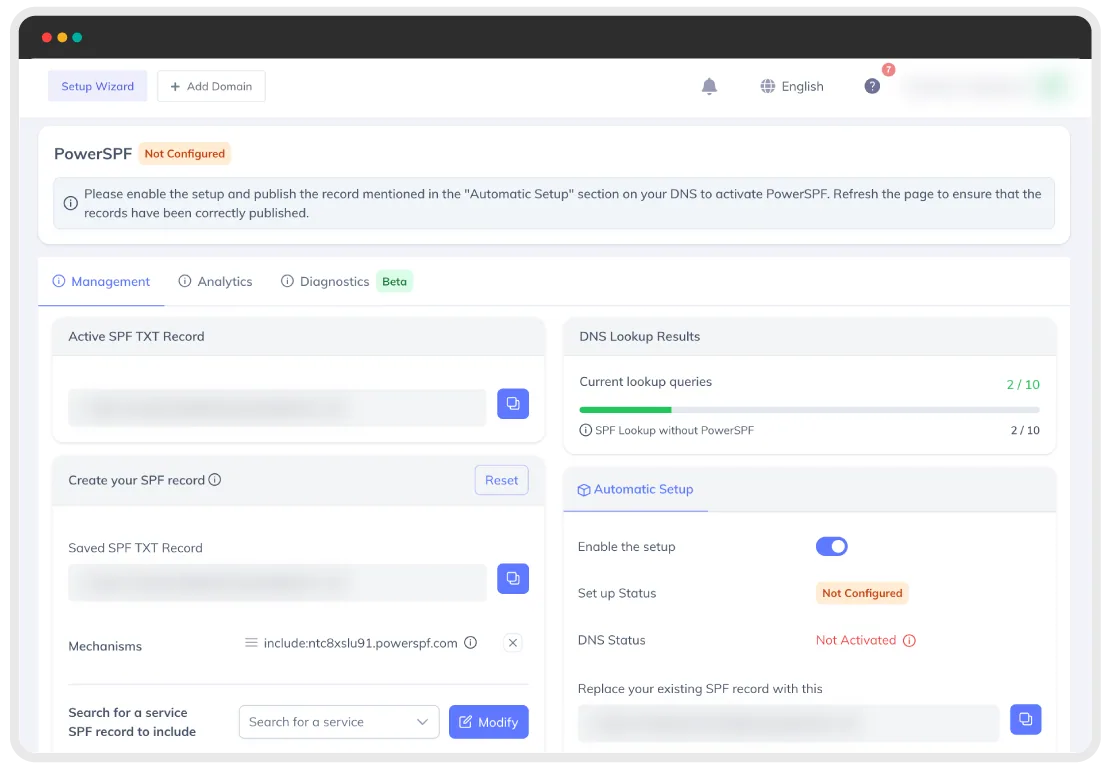



0+
Organisations worldwide0+
Fortune 100 and governments0+
Countries served

Eliminate lookup limit errors and keep SPF running automatically.
SPF returns permerror, and emails fail authentication
Adding a new sender (CRM, marketing tool) can break SPF for all senders instantly
Manual SPF flattening becomes outdated every time IPs change
Void lookups waste your lookup budget, pushing you closer to failure
SPF management is the ongoing work of keeping your SPF record accurate as your email infrastructure changes. It includes keeping your record within the 10-DNS-lookup limit and preventing configuration problems. Adding or removing third-party senders can increase DNS lookups or complicate your SPF record, potentially leading to SPF permerrors if it is not regularly maintained.
There are two ways to handle this:
This requires your team to monitor senders, update DNS records, check lookup counts, and make changes whenever your email infrastructure changes. This can become difficult to maintain across multiple domains and sending platforms.
This takes care of those ongoing changes for you. With Hosted SPF, PowerDMARC dynamically maintains your SPF record, helping keep it within the lookup limit while giving your team a central place to manage authorized senders. This reduces the need for repeated DNS edits and helps prevent SPF failures as your sending environment evolves.
For a deeper look at common SPF failures, see our guides on SPF permerror and the SPF 10 DNS lookup limit.
Hosted SPF is a cloud-based approach to SPF record management. Instead of manually updating DNS, PowerDMARC dynamically maintains your SPF record for you, ensuring it always stays within the 10 lookup limit.
You get reliable SPF record management without constant fixes, re-flattening, or risk of breakage.

Point your domain to PowerDMARC once. No complex SPF record editing.
Your SPF record is dynamically maintained to stay within lookup limits.
Add or remove services anytime. No DNS changes needed.
Track sending sources, IPs, and SPF activity in real time with built-in SPF Analytics.
Your IT or security team manually updates DNS when senders change
Requires identifying the required mechanism, editing the record, and publishing a DNS change.
Your team must monitor the record and its nested includes as the configuration grows.
Incorrect syntax, broken includes, or excessive lookups can cause SPF permerrors.
Visibility depends on your own DNS checks, documentation, and monitoring.
Each domain requires ongoing review and maintenance.
The SPF service dynamically maintains the record based on the senders you configure.
Add the sender from the management dashboard without manually editing the SPF record.
The record is automatically optimized to stay within the SPF lookup limit.
Automated optimization helps prevent common configuration issues before they affect authentication.
Sending sources, mechanisms, and IPs can be viewed from a central dashboard.
Multiple domains can be managed from one platform.

Set up your Hosted SPF with a single CNAME, then manage everything from the dashboard, no DNS access needed again!
Exceeded the lookup limit or added a new sender? Fix it instantly without any manual edits or downtime.
Track email volume per source, mechanism, and IP, even those hidden inside nested includes, with built-in SPF Analytics.
Instantly detect lookup limit violations, syntax errors, permerrors, and misconfigurations with clear remediation guidance.
Switch between high-level SPF mechanisms (include, ip4, ip6) and a flattened IP view to pinpoint exactly who’s sending on your behalf.
Get onboarding sessions and round-the-clock support so your team is never stuck managing SPF issues..
Enterprise-grade infrastructure ensures your SPF stays available and reliable at all times.
SOC2 Type 2 and ISO 27001 certified, meeting strict security and compliance requirements.
Managing SPF used to be a constant headache, especially with lookup limits. Hosted SPF completely removed that risk for us.
Stop dealing with lookup limits, broken records, and frequent failures.
Automate your SPF management with PowerDMARC.


