Free lookalike domain checker

A lookalike domain is a domain name that closely resembles a legitimate domain. These domains may be registered and controlled by third parties to impersonate an organization, mislead users, or carry out phishing and other malicious activities.
How to Use Our Lookalike Domain Checker

Step 1: Enter a domain


Step 2: Our system will generate lookalike variations


Step 3: Domains are analyzed for risk and status


Step 4: Results are categorized and displayed


How the Lookalike Domain Checker Works

Phase 1: Algorithmic Generation

We use advanced permutation engines covering homoglyphs, TLD variations, typosquatting, and more.

Phase 2: Live Status Audit

We check each domain for active/expired SSL certificates, DNS configuration, and live websites to identify potential threats.

Phase 3: Threat Intelligence

Our system flags “weaponized” domains (those with MX records or active SSL) as high-priority threats.

Types of Lookalike Domains We Detect

Typosquatting

Misspellings and keyboard errors
Example: powredmarc.com

Homoglyph Attacks

Similar-looking characters (Unicode abuse)
Example: pоwerdmarc.com

Insertion Attacks

Extra characters added to deceive
Example: powerdmarcc.com

Omission Attacks

Missing characters
Example: powedmarc.com

TLD Variations

Different extensions
Example: .net, .co, .io

Results Breakdown: What You’ll See

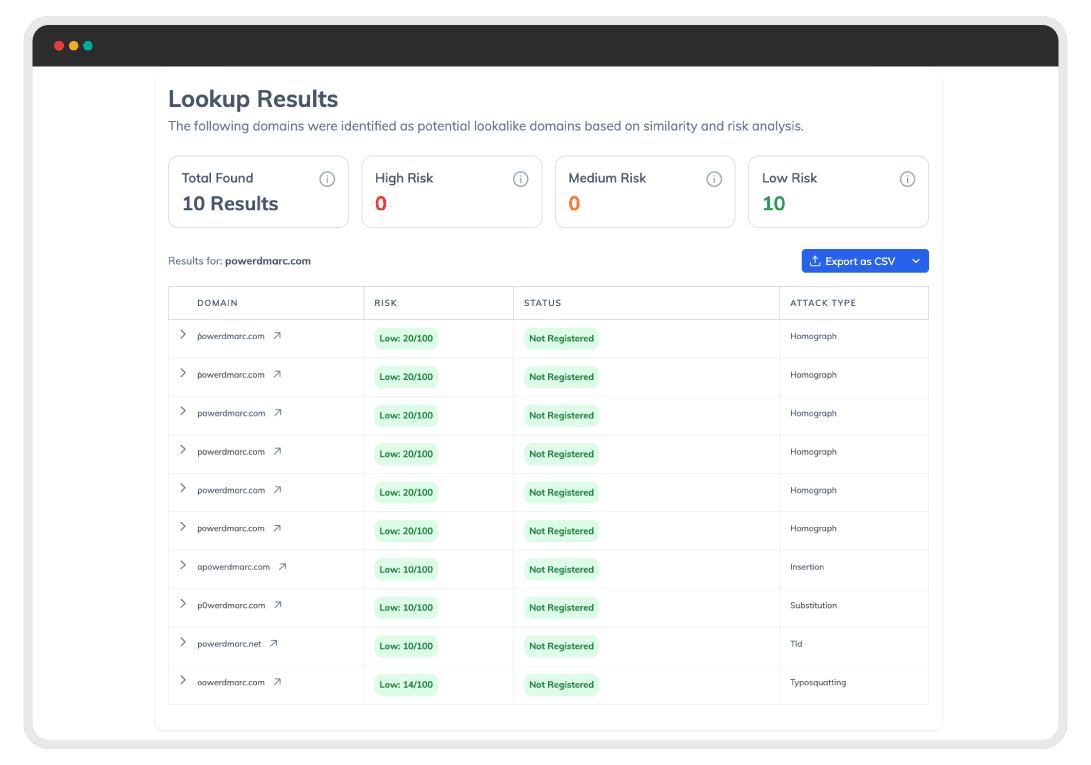
For each detected lookalike domain, we display the:

Lookalike domain name

The suspicious or impersonating domain detected

Attack type classification

The specific attack type associated with it.

Domain status

  • Not Registered Registered
  • Parked

SSL certificate status

  • Valid SSL
  • No SSL detected

Risk indicator

  • Critical: Registered + Valid SSL + MX Records (Ready for Phishing).
  • Warning: Registered but inactive.
  • Low Risk: Available for purchase (Proactive Opportunity).

What is a lookalike domain?

A lookalike domain is a domain name created to closely resemble a legitimate brand’s domain to mislead users and impersonate the brand. Lookalike domains are commonly used in phishing, email spoofing, fraud, and impersonation attacks

It typically works by using small visual or spelling tricks, such as:

Misspellings

Extra or missing characters

Different TLDs

Hyphens or added words

Why Lookalike Domains Are a Serious Risk

Lookalike domains can be seriously damaging and can pose the following risks:

They can be used in phishing and business email compromise

Enables brand impersonation

Can bypass user trust and damage reputation

Can bypass email authentication protocols like DMARC, SPF, and DKIM.

In 2025, 1.5 Million Domains Were Used in Lookalike Domain Phishing Attacks

Take Action: Prevent Abuse Before It Starts

Defensive Registration

Buy the high-risk “Available” domains before attackers do. Park domains to prevent misuse.

Takedown Readiness

Export a CSV of “High” threats to send to your legal team or hosting providers.

Continuous Monitoring

Don’t stop here. Connect this to your DMARC monitoring to detect which IPs are trying to use these domains to impersonate your organization

Can also use: Use Hosted DMARC in order to see which IPs might be trying to send out spoofing attacks from these domains

Frequently Asked Questions

Attackers use visually similar domains to trick users into trusting fake emails or websites, making them more likely to share credentials or sensitive data.

Defensive domain registration can reduce risk, but not completely eradicate it. Registering similar domains should be combined with proactive monitoring, since attackers can still create new variations of your domain continuously.

Lookalike domains can have valid SSL certificates, which makes them appear legitimate and increases the chance of user trust.

It is recommended to check lookalike threats frequently, as new lookalike domains can be registered and weaponized within hours.

Stop Brand Impersonation Before It Starts