Best CRMs for Email Marketing: Tools for Better Deliverability, Security, and Campaign Performance

by
Reading Time: 6 min

by
Key Takeaways
Email marketing, as a practice, continues to evolve with the introduction of new tools that make campaigns smarter, facilitated through automation and artificial intelligence (AI). Email CRMs are expected to automate and analyze communications while managing a customer database. Email marketing CRMs integrate inbox communication and reporting with email analytics and segmentation to make automating emails as email campaigns more efficient.
Email Marketing CRMs reduce strategic Slack communications from teams, and automatic campaigns make email deliverability and marketing performance more effective.
A good CRM for email marketing does more than just store contacts – it helps your team work smarter, run campaigns efficiently, and connect with the right people at the right time. The best platforms combine powerful features with usability, so your team isn’t overwhelmed. Key things to look for include:
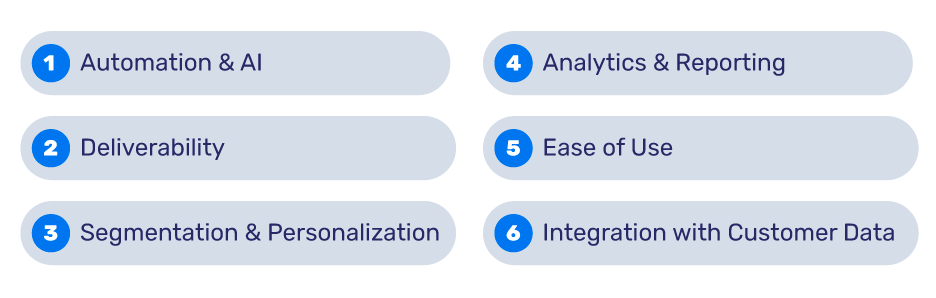
Ultimately, the best email marketing CRMs strike a balance between functionality and simplicity, helping your team achieve better results without burning out.
Email security is crucial to the success of campaigns. CRMs now incorporate SPF, DKIM, and DMARC authentication to defend sending domains and bolster brand trust. Permission settings, audit trails, and controlled sending help mitigate the risk of abuse, while spam and reputation safeguards help to ensure the inbox target is hit.
This is where dedicated authentication platforms like PowerDMARC add real value. While CRMs provide the basics, PowerDMARC delivers deeper visibility, continuous monitoring, and automated enforcement across complex domain environments. This ensures that marketing teams aren’t just compliant on paper, but truly protected – with full insight into who’s sending on their behalf and whether every message aligns with policy.
With an ever-increasing email volume and with email providers making it harder to hit the inbox target, these protections enable more consistent engagement and results.
monday.com CRM unites marketing, sales, and communication activities into a singular workspace. This allows teams to plan, send, and analyze campaigns without jumping between different systems. It’s a great fit for fast-moving enterprises that require cross-channel visibility, and its Work Management integration streamlines the coordination of content, scheduling, and shared assets to reduce delays.
AI and automation provide the most benefit to businesses. Users of automation tools experience a productivity increase of close to 90%, according to the 2025 State of Sales Technology Report. With the monday CRM, businesses instantly receive AI-generated insights to track customer engagement and build quality lead funnels. monday has been recognized in the Gartner Magic Quadrants for Sales Force Automation and has surpassed $100 million in annual recurring revenue, with an increase in sales to enterprise customers. More robust tools are included in the higher tiers, and onboarding may be required for full feature utilization, but for multi-channel campaigns, there is a quality mix of agility, clarity, and depth in the tool’s features.
Best For:
If an organization has a content-driven strategy focused on inbound marketing, HubSpot CRM is a good fit. It has fantastic performance dashboards for email, content, and social, enabling teams to fine-tune messaging and gain a better insight into the audience. Marketers get the opportunity to test different versions of a campaign and fine-tune elements like activation timing, tone, and audience segments through A/B testing and behavioral analytics.
Divisional teams, whether small or large, can benefit from the integration of content management, automation and CRM systems. Teams that heavily rely on customer engagement can benefit from reliable systems. However, underdeveloped systems will rely on minimalistic features, and systems will typically become more expensive when customer lists become oversized. This can be a big disadvantage to small teams, but strong referencing and systems take precedence over the balance of complicated systems.
Best For:
Enterprises that operate on a large scale and deal with intricate customer journeys are in the target market for Salesforce Marketing Cloud. There is a robust personalization based on predictive analytics and behavioral segmentation with the Einstein AI-powered tools, which makes tailoring campaigns much more precise. Being a part of the wider Salesforce ecosystem ensures that the connected sales, service, and marketing workflows work together seamlessly.
Automation on a grand scale and customization are the main strengths of the platform. Companies have the best customer experience tools. However, the cost is on the higher side, and it is a more complicated platform. Only large organizations, which can cover the costs, should consider this. Small, less complex teams may find the system a bit overcomplicated. But large enterprises will find the system invaluable and will be able to use the tools to help easily run multiple high-volume campaigns.
Best For:
For small teams handling sales and marketing, budget-friendly and more accessible options can be found with Zoho CRM. There is no added complication with the system when you use it with Zoho Campaigns, which helps with newsletters, follow-up sequences, and response tracking. Integrations with Google Workspace, Microsoft, and other collaboration tools are seamless in the system.
Zoho’s Zia assistant offers predictive suggestions that streamline routine tasks, though its analytics and segmentation are less advanced than enterprise-level systems. This makes it particularly suitable for early-stage businesses that prioritize affordability and simplicity over deep customization or complex automation.
Best For:
Pipedrive primarily aims at helping sales teams streamline their communication and develop clear pipeline visibility. The email features are intuitive and simple, and they make outreach, follow-up tracking, and template high-volume email sends almost effortless. This simplicity allows teams to get to work without wasting time on complex tools.
Although its analytics and marketing capabilities are more limited compared with platforms designed for large-scale campaign management, Pipedrive works well for organizations prioritizing lead management, consistent communication, and ease of use. It fits best with teams that want a focused system rather than an all-encompassing marketing platform.
Best For:
There are many organizations with a plethora of CRMs. The best option for most of them is one that promotes teamwork, is able to give reliable metrics, and is flexible enough to adjust to the customer movements.
Picking a CRM correlates with the goals and structure of the organization. Big and complex teams with more intricate workflows benefit from advanced segmentation and targeting AI insights. Smaller organizations, on the other hand, often derive the most value from simplicity and automation geared towards streamlining processes.
Match Features to Team Size and Complexity: Choose a CRM that fits your team’s size and workflow – advanced features for large teams, simplicity for smaller ones.
Decide How Much Automation You Need: Pick a CRM with the right level of automation – enough to save time, but not so complex it overwhelms your team.
Evaluate Deliverability and Security Capabilities: Ensure the CRM supports SPF, DKIM, DMARC, and offers insights to keep emails reaching the inbox.
Map CRM Workflows to Your Marketing Goals: Align the CRM with your objectives – segmentation, personalization, and campaign tracking should match your strategy.
There are many organizations with a plethora of CRMs. The best option for most of them is one that promotes teamwork, is able to give reliable metrics, and is flexible enough to adjust to the customer movements.
When teams are able to correlate their workflow, the level of desired personalization and CRM with the goals, they are able to more efficiently deliver, enhance the interactivity of the campaigns, and adapt to the shift of the audience.
CRMs are now the central command within a company. They handle planning, customization, audience segmentation, email deployment, and post-campaign analytics. As email becomes the primary communication tool and is more linked to first-party data, teams depend on CRMs to guide their email marketing with high precision.
Selecting the right CRM isn’t just about features – it’s about how it fits your team, supports your strategy, and protects your emails. A platform that balances automation, personalization, and workflow efficiency, while ensuring strong deliverability and domain security, will help your campaigns perform at their best. By aligning your CRM choice with your marketing goals and email authentication practices, you set your team up for smoother campaigns, higher engagement, and measurable results.