
India DMARC & MTA-STS Adoption Report 2026

As one of the world’s fastest-growing digital economies and a global hub for IT services, digital public infrastructure, and fintech innovation, organizations across India, spanning commercial banks, government ministries, energy utilities, and enterprise corporations, navigate an intensifying cyber threat landscape in 2026. Cybercriminals increasingly target Indian enterprises and citizens with sophisticated Business Email Compromise (BEC), Unified Payments Interface (UPI) and tax-refund phishing lures, and executive brand impersonation. 

While India has reinforced its national cyber governance through the Indian Computer Emergency Response Team (CERT-In) Cyber Security Directions under Section 70B of the Information Technology Act, 2000 and the Reserve Bank of India (RBI) Cybersecurity, Technology Risk, Resilience and Assurance Framework Directions, 2026, major operational gaps persist across corporate and public email ecosystems. A nationwide evaluation shows that although foundational SPF deployment is well established, nearly one-third of Indian domains still omit DMARC records altogether, and server-to-server transport encryption remains virtually absent, leaving vital communications exposed to direct-domain spoofing and transit-layer interception.
At a Glance: Key Findings Across India

Our nationwide audit of India’s domain infrastructure highlights solid baseline sender authorization balanced against widespread enforcement, routing, and transport-layer voids:

spf

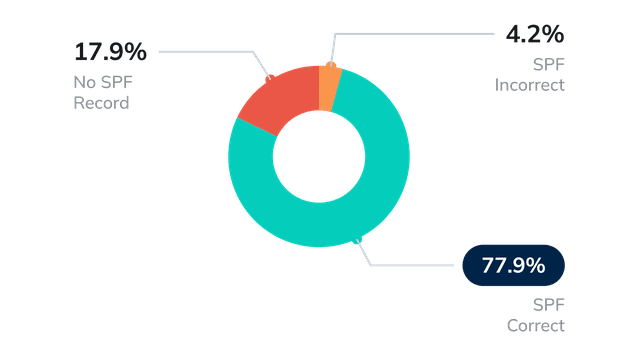
Established SPF Baseline (77.9% Correct): Over three-quarters of evaluated Indian domains maintain valid sender authorization, with 77.9% publishing syntactically accurate SPF records. However, 17.9% omit SPF records completely, and 4.2% contain configuration errors or lookup threshold violations.

dmarc

Split DMARC Enforcement & Unconfigured Gap (25.0% at p=reject): Across India, exactly one-quarter (25.0%) of analyzed domains enforce a strict p=reject policy. Combined with p=quarantine (25.6%), total active enforcement reaches 50.6%. Yet nearly half of the country remains exposed to spoofing: 31.3% publish no DMARC record at all, 17.1% remain stalled in passive observation (p=none), and 1.0% contain syntax flaws.

India DMARC report

Pervasive In-Transit Security Deficit (98.8% Missing MTA-STS): Server-to-server email transit security is largely unaddressed nationwide. A critical 98.8% of Indian domains lack an MTA-STS record, leaving SMTP mail exchanges reliant on opportunistic STARTTLS and exposed to Man-in-the-Middle (MiTM) downgrade attacks, while only 1.2% deploy valid transit protection.

dnssec

Widespread DNSSEC Non-Deployment (11.6% DNSSEC Enabled): A substantial 88.4% of evaluated Indian domains operate without DNSSEC validation. With only 11.6% having activated cryptographic signing, the national domain landscape remains vulnerable to DNS cache poisoning and unauthorized lookup redirection.

Sector-by-Sector Analysis

1. Financial Services (Banking): National Leader in Strict Enforcement and DNSSEC

Regulated under the Reserve Bank of India (RBI) Cybersecurity, Technology Risk, Resilience and Assurance Framework Directions, 2026, India’s banking institutions lead all analyzed sectors in both strict p=reject enforcement and DNSSEC signing, though transit encryption remains entirely unconfigured.

Protocol Metric Current Status
SPF Accuracy 78.1% Correct (7.8% Incorrect, 14.1% No Record)
DMARC Reject Policy 61.7% (National Leader)
DMARC Policies 18.0% Quarantine, 3.1% None
DMARC Gap 17.2% Missing Record
MTA-STS Adoption 0.0% Valid (100.0% No Record)
DNSSEC Adoption 41.4% Enabled (National Leader, 58.6% Disabled)
financial-services_spf

Vulnerability Exposure

Indian banks achieve a 79.7% aggregate enforcement posture (p=reject at 61.7% and p=quarantine at 18.0%) alongside national leadership in DNSSEC enablement (41.4%). However, 17.2% of banking domains still publish no DMARC record, 14.1% omit SPF, and 7.8% exhibit SPF configuration errors. Most critically, 100.0% of evaluated banking domains lack MTA-STS, leaving customer financial alerts and interbank correspondence susceptible to transport-layer eavesdropping.

The PowerDMARC Strategy

PowerDMARC equips commercial banks, payment banks, and financial institutions with hosted MTA-STS and automated TLS-RPT reporting, enforcing encrypted server-to-server mail delivery without interrupting high-volume transactional notifications.

2. Business (Enterprise & Commercial): National Leader in Transit Security Amid Monitoring Bottlenecks

India’s corporate enterprises and technology firms form the backbone of the private economy, leading all analyzed industries in MTA-STS adoption while exhibiting the highest passive p=none rate in the country.

Protocol Metric Current Status
SPF Accuracy 82.4% Correct (6.8% Incorrect, 10.8% No Record)
DMARC Reject Policy 25.6% (p=reject)
DMARC Policies 26.8% Quarantine, 28.0% None
DMARC Gap 17.6% Missing Record, 2.0% Incorrect
MTA-STS Adoption 4.4% Valid (National Leader, 95.6% No Record)
DNSSEC Adoption 12.8% Enabled (87.2% Disabled)
business_dmarc

Vulnerability Exposure

Business domains achieve a 52.4% combined enforcement rate (p=reject at 25.6% and p=quarantine at 26.8%) and set the national benchmark for MTA-STS deployment at 4.4%. Nevertheless, 28.0% remain stalled in passive monitoring (p=none), 17.6% omit DMARC entirely, and 2.0% contain malformed syntax, leaving B2B supply chains and corporate procurement channels exposed to invoice fraud and executive impersonation.

The PowerDMARC Strategy

PowerDMARC accelerates enterprise progression from p=none to full p=reject enforcement while automating SPF flattening (PowerSPF) across complex multi-cloud SaaS environments.

3. Public Sector (Government): Highest Combined Enforcement, Minimal DNSSEC

Central ministries, state departments, and statutory agencies demonstrate India’s highest combined DMARC enforcement posture and second-highest SPF accuracy, though DNSSEC and MTA-STS lag significantly.

Protocol Metric Current Status
SPF Accuracy 86.3% Correct (1.7% Incorrect, 12.0% No Record)
DMARC Reject Policy 39.3% (p=reject)
DMARC Policies 41.9% Quarantine, 6.0% None
DMARC Gap 11.1% Missing Record, 1.7% Incorrect
MTA-STS Adoption 0.0% Valid (100.0% No Record)
DNSSEC Adoption 2.6% Enabled (97.4% Disabled)
public-sector_mta-sts

Vulnerability Exposure

Public sector domains record an impressive 81.2% combined enforcement rate (p=reject at 39.3% and p=quarantine at 41.9%) and 86.3% SPF accuracy. Still, 11.1% omit DMARC records altogether, 97.4% operate without DNSSEC validation, and 100.0% lack MTA-STS, leaving citizen-facing communications and administrative portals exposed to domain spoofing and routing manipulation.

The PowerDMARC Strategy

Our multi-tenant governance platform empowers ministerial IT teams to elevate p=quarantine policies to strict p=reject enforcement and deploy hosted MTA-STS across departmental subdomains.

4. Education: Solid Active Enforcement Offset by Lowest DNSSEC Coverage

Universities, research institutes, and academic networks manage sprawling student and faculty ecosystems, demonstrating strong combined DMARC enforcement alongside the country’s lowest DNSSEC rate.

Protocol Metric Current Status
SPF Accuracy 84.0% Correct (4.9% Incorrect, 11.1% No Record)
DMARC Reject Policy 24.7% (p=reject)
DMARC Policies 35.8% Quarantine, 22.2% None
DMARC Gap 17.3% Missing Record
MTA-STS Adoption 0.0% Valid (100.0% No Record)
DNSSEC Adoption 2.5% Enabled (Sector Low, 97.5% Disabled)
education_dnssec

Vulnerability Exposure

Educational institutions achieve 60.5% aggregate enforcement (p=reject at 24.7% and p=quarantine at 35.8%) and 84.0% SPF accuracy. However, 22.2% remain parked at p=none, 17.3% omit DMARC entirely, 97.5% lack DNSSEC, and 100.0% have no MTA-STS record, exposing admissions portals and academic staff to credential harvesting and phishing lures.

The PowerDMARC Strategy

Academic networks routinely exceed the 10-DNS-lookup limit due to decentralized departmental mailers and learning platforms. Dynamic PowerSPF flattening prevents lookup errors and safeguards campus deliverability.

5. Energy: High DMARC Omissions and Weak SPF Baseline

India’s power generation, oil and gas, and grid distribution enterprises represent critical national infrastructure, yet exhibit high DMARC and SPF omission rates.

Protocol Metric Current Status
SPF Accuracy 71.0% Correct (1.9% Incorrect, 27.1% No Record)
DMARC Reject Policy 18.1% (p=reject)
DMARC Policies 25.1% Quarantine, 11.6% None
DMARC Gap 45.2% Missing Record
MTA-STS Adoption 0.0% Valid (100.0% No Record)
DNSSEC Adoption 11.6% Enabled (88.4% Disabled)
energy_spf

Vulnerability Exposure

Nearly half (45.2%) of evaluated energy domains publish no DMARC record and 27.1% omit SPF entirely, while active p=reject enforcement stands at 18.1%. Coupled with 0.0% MTA-STS coverage and 88.4% DNSSEC non-deployment, utility supply chains and industrial procurement channels face elevated risks of targeted executive spear-phishing and vendor fraud.

The PowerDMARC Strategy

PowerDMARC pairs automated policy enforcement with hosted MTA-STS to insulate critical energy infrastructure against BEC and connection downgrade attacks.

6. Healthcare: Widespread DMARC Absence Despite Marginal Transit Adoption

Handling confidential patient diagnostics and hospital records, India’s healthcare sector suffers from substantial DMARC non-deployment alongside minimal transit protection.

Protocol Metric Current Status
SPF Accuracy 74.5% Correct (0.7% Incorrect, 24.8% No Record)
DMARC Reject Policy 11.3% (p=reject)
DMARC Policies 19.2% Quarantine, 23.4% None
DMARC Gap 45.4% Missing Record, 0.7% Incorrect
MTA-STS Adoption 0.7% Valid (99.3% No Record)
DNSSEC Adoption 6.4% Enabled (93.6% Disabled)
healthcare_dmarc

Vulnerability Exposure

Over two-fifths (45.4%) of healthcare domains lack DMARC entirely and nearly a quarter (24.8%) omit SPF, while strict p=reject enforcement reaches only 11.3%. Although healthcare is one of only four Indian sectors with measurable MTA-STS deployment (0.7%), 99.3% remain unencrypted in transit and 93.6% lack DNSSEC, leaving medical networks vulnerable to ransomware lures and patient-targeted phishing.

The PowerDMARC Strategy

We guide hospital groups and diagnostic laboratories through a managed rollout to p=reject, safeguarding patient confidentiality and clinical communications without disrupting medical dispatch workflows.

7. Media: Acute Authentication Deficit Across All Protocols

Indian broadcast networks, digital news platforms, and publishing houses record the highest DMARC and SPF omission rates among all evaluated sectors.

Protocol Metric Current Status
SPF Accuracy 67.7% Correct (Sector Low, 3.0% Incorrect, 29.3% No Record)
DMARC Reject Policy 7.9% (Sector Low)
DMARC Policies 7.9% Quarantine, 23.8% None
DMARC Gap 58.6% Missing Record (National Highest), 1.8% Incorrect
MTA-STS Adoption 0.0% Valid (100.0% No Record)
DNSSEC Adoption 4.3% Enabled (95.7% Disabled)
media_mta-sts

Vulnerability Exposure

Nearly three-fifths (58.6%) of media domains publish no DMARC record and 29.3% omit SPF, while strict p=reject enforcement sits at a sector-low 7.9% (15.8% combined enforcement). With 0.0% MTA-STS adoption and 95.7% DNSSEC non-deployment, news outlets and publishers are heavily exposed to brand spoofing, fabricated press releases, and editorial impersonation.

The PowerDMARC Strategy

Implementing Brand Indicators for Message Identification (BIMI) alongside enforced p=reject enables newsrooms and broadcasters to display verified brand logos in subscriber inboxes while shutting down domain impersonation.

8. Telecommunications: Highest SPF Accuracy and Strong Combined Enforcement

Overseeing nationwide mobile networks and digital connectivity infrastructure, India’s telecom providers lead all sectors in SPF accuracy while maintaining high combined DMARC enforcement.

Protocol Metric Current Status
SPF Accuracy 89.5% Correct (National Leader, 4.5% Incorrect, 6.0% No Record)
DMARC Reject Policy 20.9% (p=reject)
DMARC Policies 41.8% Quarantine, 11.9% None
DMARC Gap 25.4% Missing Record
MTA-STS Adoption 0.0% Valid (100.0% No Record)
DNSSEC Adoption 9.0% Enabled (91.0% Disabled)
India DMARC report

Vulnerability Exposure

Telecommunications carriers achieve national leadership in SPF accuracy (89.5%) and a 62.7% combined DMARC enforcement rate (p=reject at 20.9% and p=quarantine at 41.8%). However, one-quarter (25.4%) of telecom domains still omit DMARC records, 91.0% operate without DNSSEC, and 100.0% lack MTA-STS, leaving subscriber billing alerts and carrier notifications vulnerable to account takeover lures.

The PowerDMARC Strategy

PowerDMARC streamlines the transition from p=quarantine to full p=reject across high-volume carrier infrastructure, blocking unauthorized domain spoofing without impeding subscriber messaging.

9. Transport & Logistics: Balanced Enforcement with Modest Transit Protection

Supporting India’s aviation, maritime ports, rail freight, and supply-chain corridors, transport and logistics operators combine solid DMARC enforcement with measurable MTA-STS deployment.

Protocol Metric Current Status
SPF Accuracy 76.8% Correct (4.6% Incorrect, 18.6% No Record)
DMARC Reject Policy 22.5% (p=reject)
DMARC Policies 30.5% Quarantine, 11.9% None
DMARC Gap 34.4% Missing Record, 0.7% Incorrect
MTA-STS Adoption 2.0% Valid (98.0% No Record)
DNSSEC Adoption 9.9% Enabled (90.1% Disabled)
transport-logistics_spf

Vulnerability Exposure

Transport and logistics enterprises achieve a 53.0% aggregate enforcement rate (p=reject at 22.5% and p=quarantine at 30.5%) and rank second nationally in MTA-STS adoption at 2.0%. Nevertheless, over one-third (34.4%) omit DMARC records, 18.6% lack SPF, and 98.0% have no MTA-STS configured, exposing shipping manifests, customs documentation, and freight invoices to interception and payment diversion.

The PowerDMARC Strategy

PowerDMARC secures logistics and supply-chain communications with automated MTA-STS transit encryption and granular DMARC enforcement, protecting electronic bills of lading and trade invoices prior to inbox arrival.

Sector-Level DMARC Adoption in India

% DMARC Adoption – India

India DMARC report

India demonstrates robust active email authentication enforcement across several crucial industries, spearheaded by the Banking sector, where 79.7% of domains actively enforce protection (p=quarantine at 18.0% and p=reject at a national high of 61.7%). Government agencies also display strong risk-reduction metrics with a combined enforcement rate of 81.2% (p=quarantine at 41.9% and p=reject at 39.3%). Both Telecommunications (62.7% combined) and Education (60.5% combined) demonstrate commendable enforcement discipline.

Conversely, Media remains the most vulnerable sector, with 58.6% of domains lacking any DMARC record and only a minimal 7.9% adopting a strict p=reject policy. A significant share of the Healthcare (45.4%) and Energy (45.2%) sectors similarly operate without any published DMARC guidelines, highlighting critical opportunities for baseline defense adoption. In the Business sector, while overall deployment is active, a notable 28.0% of domains remain parked in passive monitoring (p=none), identifying a key area to elevate and harden existing policies to prevent impersonation and fraud.

Deep Dive: Four Systemic Vulnerabilities in Indian Domains

1. The Unconfigured DMARC Gap: Nearly One-Third of Domains Unprotected

Across India, 31.3% of evaluated domains publish no DMARC record whatsoever, and another 1.0% contain syntax errors. Without a valid DMARC record instructing receiving mail servers how to handle unauthenticated messages, cybercriminals can spoof legitimate Indian brands and institutions with minimal resistance.

Expert insight:

“Operating without a valid DMARC record leaves an organization’s domain wide open to direct impersonation. When nearly a third of evaluated domains across a major digital economy lack basic DMARC instructions, attackers can abuse trusted local brands to launch large-scale fraud. Enforced authentication is non-negotiable for digital resilience.”

India DMARC report

Maitham Al Lawati, CEO, PowerDMARC

Expert insight:

“Deploying DMARC at p=none without a structured timeline toward enforcement creates a false sense of security. Visibility is only the first step; organizations must progress to p=quarantine and p=reject to actively stop spoofed emails before they reach the inbox.”

India DMARC report

Yunes Tarada, Service Delivery Manager, PowerDMARC

2. The Monitoring Plateau: Treating p=none as a Permanent State

Another 17.1% of Indian domains remain parked in passive observation (p=none). While monitoring mode provides critical visibility into legitimate sending infrastructure during initial onboarding, an unenforced policy offers zero active blocking against forged messages reaching employees, citizens, or customers.

3. MTA-STS Omission: Widespread Exposure to Transit Downgrade Attacks

With 98.8% of evaluated Indian domains lacking MTA-STS records, external email delivery relies almost entirely on opportunistic STARTTLS. Adversaries positioned along network transit paths can execute TLS-stripping and Man-in-the-Middle (MiTM) downgrade attacks, intercepting sensitive financial instructions and corporate communications in cleartext.

Expert insight:

“Opportunistic encryption cannot guarantee confidentiality for high-stakes financial and enterprise communications. Without enforced MTA-STS policies, attackers can silently downgrade SMTP connections to cleartext. Transitioning to mandatory TLS in transit is essential for protecting sensitive data.”

India DMARC report

Ayan Bhuiya, Operations & Delivery Shift Lead, PowerDMARC

Expert insight:

“Downstream email security controls depend directly on the integrity of the underlying DNS layer. DNSSEC supplies the cryptographic verification confirming that mail servers and users are communicating with authentic infrastructure rather than a fraudulent intermediary.”

India DMARC report

Engjell Koliqi, Marketing Manager, PowerDMARC

4. DNSSEC Deficits: Vulnerability at the Resolution Layer

A substantial 88.4% of analyzed Indian domains operate without DNSSEC validation. Without cryptographic signatures verifying DNS lookup responses, domains remain susceptible to DNS cache poisoning and spoofed resolution records, enabling attackers to covertly reroute inbound mail flows or hijack authentication checks.

Global Benchmarking: India in Context

India’s 2026 email authentication metrics demonstrate competitive p=reject enforcement, outperforming several major European markets, while highlighting clear opportunities to strengthen foundational SPF accuracy, DNSSEC signing, and MTA-STS adoption.

The Global Leaderboard: 2026 Comparative Data

Country / Territory SPF Correct DMARC Reject MTA-STS Valid DNSSEC Enabled
Denmark 96.8% 57.6% 3.0% 65.8%
USA 95.7% 49.0% 1.7% 18.0%
UK 93.7% 44.1% 20.6% 3.8%
France 95.6% 28.3% 2.6% 17.9%
India 77.9% 25.0% 1.2% 11.6%
Ecuador 96.1% 24.9% 1.4% 4.8%
Netherlands 70.0% 23.2% 0.9% 37.7%
Poland 98.9% 21.2% 0.9% 15.7%
Brazil 92.1% 20.7% 0.7% 21.9%
Austria 97.0% 19.7% 1.9% 7.1%
Romania 97.1% 17.3% 1.8% 7.0%
Switzerland 96.0% 16.8% 4.4% 32.6%
Italy 91.0% 16.7% 1.0% 3.5%

India in the Global Spotlight: 2026 Analysis

1
Enforcement Posture

India’s 25.0% p=reject rate surpasses regional and European peers, including Ecuador (24.9%), the Netherlands (23.2%), Poland (21.2%), Brazil (20.7%), Austria (19.7%), and Italy (16.7%), while trailing global leaders such as Denmark (57.6%), the USA (49.0%), and the UK (44.1%).

2
Transit Encryption

At 1.2% MTA-STS validity, India edges ahead of Italy (1.0%), the Netherlands (0.9%), Poland (0.9%), and Brazil (0.7%), though it remains well behind transport-security frontrunners like the UK (20.6%) and Switzerland (4.4%).

3
DNSSEC Standing

With 11.6% DNSSEC adoption, India outperforms Austria (7.1%), Romania (7.0%), Ecuador (4.8%), the UK (3.8%), and Italy (3.5%), while trailing mature cryptographic registries such as Denmark (65.8%), the Netherlands (37.7%), and Switzerland (32.6%).

The PowerDMARC Viewpoint

“India’s regulatory momentum, driven by CERT-In’s Cyber Security Directions and the Reserve Bank of India’s 2026 Cybersecurity and Resilience Framework, demonstrates a decisive commitment to safeguarding national digital infrastructure. While Indian banking and government sectors set strong benchmarks in active DMARC enforcement, nearly a third of domains nationwide still lack DMARC records, and almost 99% omit MTA-STS. Closing these operational gaps is critical to protecting India’s rapidly expanding digital economy against impersonation and transit interception.”

Strategic Roadmap: Transitioning to Active Protection

To remediate domain vulnerabilities and align with CERT-In and RBI cybersecurity mandates, organizations across India should prioritize three technical actions:

Close DMARC Omissions and Advance to p=reject

Publish valid DMARC records across the 31.3% of unconfigured domains (and fix the 1.0% with syntax errors), then migrate the 17.1% parked at p=none through p=quarantine to strict p=reject enforcement.

Deploy Hosted MTA-STS and TLS-RPT

Eliminate the 98.8% transit encryption gap by implementing hosted MTA-STS alongside TLS reporting telemetry, guaranteeing encrypted server-to-server delivery for inbound SMTP communications.

Remediate SPF Gaps with Dynamic Flattening

Address the 17.9% of domains missing SPF records and the 4.2% experiencing configuration or lookup errors by deploying automated SPF flattening (PowerSPF) to prevent 10-lookup ceiling failures across cloud integrations.

Methodology, Research & Data Sources

DNS Record Analysis

Automated DNS query operations were conducted across India’s commercial, public, and institutional domain spaces to evaluate SPF, DMARC, MTA-STS, and DNSSEC configurations against RFC standards.

Sector Sampling

Evaluated domains were categorized across nine foundational sectors shaping India’s economy and public infrastructure:

  • Banking (Financial Services)
  • Business (Enterprise & Commercial)
  • Public Sector (Government)
  • Education
  • Energy
  • Healthcare
  • Media
  • Telecommunications
  • Transport & Logistics

Risk Classification

Sectoral and nationwide risk profiles are evaluated based on active p=reject and p=quarantine enforcement rates, DMARC omission and syntax error levels, SPF accuracy, and the implementation of MTA-STS and DNSSEC protections.

Transforming Indian Domain Visibility into Active Defense

Indian enterprises, financial institutions, and public agencies have built a strong foundation in active DMARC enforcement; the next milestone is eliminating unconfigured domain gaps and securing the mail transit layer. Partner with PowerDMARC to assess, automate, and harden your organization’s email authentication posture.