
Switzerland DMARC & MTA-STS Adoption Report 2026

An exhaustive national audit across Swiss digital assets reveals that while baseline domain hygiene is widely maintained, organizational hesitation to enforce strict protection policies leaves key sectors exposed to Business Email Compromise (BEC), CEO fraud, and transport-layer eavesdropping. This exposure is particularly urgent in light of evolving regulatory requirements, including the revised Swiss Information Security Act (ISA), which introduced strict reporting obligations for critical infrastructure operators to report cyber incident vectors to the National Cyber Security Centre (NCSC) within 24 hours, as well as the enforced revised Federal Act on Data Protection (nFADP / revDSG) and financial sector standards from FINMA.
At a Glance: Key Findings Across Switzerland

Our nationwide audit evaluating domain security postures across Swiss organizations highlights distinct operational achievements alongside structural defenses that remain incomplete:

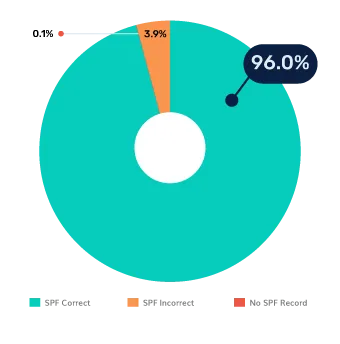
Switzerland-SPF

SPF Baseline Discipline (96.0% Correct): Swiss organizations demonstrate solid baseline protocol administration, with 96.0% publishing syntactically valid SPF records, 3.9% containing formatting errors, and only 0.1% lacking SPF entirely.

Switzerland-DMARC

The DMARC Enforcement Gap (Only 16.8% at p=reject): While 76.6% of assessed Swiss domains publish a DMARC policy, only 16.8% enforce a full protective p=reject policy to actively drop unauthorized emails. The majority remain exposed under passive monitoring (p=none at 34.3%), soft quarantine rules (p=quarantine at 24.9%), record syntax errors (0.6%), or no DMARC record whatsoever (23.4%).

Switzerland-MTA-STS

MTA-STS In-Transit Exposure (95.6% Unsecured): Server-to-server mail transit encryption remains largely unmanaged nationwide. An overwhelming 95.6% of Swiss domains lack an MTA-STS policy, leaving mail flows exposed to Man-in-the-Middle (MiTM) TLS downgrade attacks, while only 4.4% maintain valid enforcement.

Switzerland-DNSSEC

DNSSEC Adoption Strength (32.6% Enabled): In contrast to many European peers, Switzerland demonstrates strong adoption of DNSSEC, with 32.6% of analyzed domains utilizing cryptographic DNS signatures to prevent cache poisoning and DNS spoofing, though 67.4% still operate without this protection layer.

Sector-by-Sector Analysis

1. Financial Services (Banking): High Baseline Visibility, Delayed Enforcement

Swiss financial institutions handle significant cross-border wealth and sensitive transaction data. While baseline SPF accuracy and DMARC deployment are high, the sector heavily relies on passive monitoring rather than active rejection policies.

Protocol Metric Current Status
SPF Accuracy 98.4% Correct (1.6% Incorrect)
DMARC Reject Policy 12.1% (p=reject)
DMARC Policies 23.4% Quarantine, 52.4% None
DMARC Gap 11.3% Missing Record, 0.8% Incorrect
MTA-STS Adoption 3.2% Valid (96.8% Unsecured)
DNSSEC Adoption 24.2% Enabled (75.8% Disabled)
Banking-SPF-Adoption-Switzerland

Vulnerability Exposure

Despite financial regulatory scrutiny from FINMA, over half (52.4%) of banking domains remain parked at p=none, where fraudulent emails using bank domains are still delivered to recipients. Only 12.1% enforce p=reject. Furthermore, 96.8% lack MTA-STS transport encryption, leaving inter-bank and customer email exchanges vulnerable to intercept threats.

The PowerDMARC Strategy

PowerDMARC helps financial institutions safely transition from passive monitoring (p=none) to strict enforcement (p=reject) using automated AI-driven sender verification and RUA/RUF threat intelligence. Our hosted MTA-STS service enforces strict TLS transport protection without manual certificate management overhead.

2. Healthcare: Significant Exposure and Widespread DMARC Absence

Swiss health networks and medical institutions process confidential patient records and critical operational communications, yet display some of the highest domain security gaps in the nation.

Protocol Metric Current Status
SPF Accuracy 93.8% Correct (5.8% Incorrect, 0.4% No Record)
DMARC Reject Policy 17.4% (p=reject)
DMARC Policies 17.0% Quarantine, 29.9% None
DMARC Gap 34.4% Missing Record, 1.3% Incorrect
MTA-STS Adoption 1.8% Valid (98.2% Unsecured)
DNSSEC Adoption 35.7% Enabled (64.3% Disabled)
Healthcare-DMARC-Adoption-Switzerland

Vulnerability Exposure

Healthcare exhibits the highest DMARC absence rate (34.4%) among major utility and public services sectors in Switzerland. Coupled with 1.3% invalid records and 29.9% passive monitoring, over 65% of healthcare domains provide zero active defense against impersonation, leaving medical networks vulnerable to spear-phishing and ransomware.

The PowerDMARC Strategy

We empower healthcare institutions to secure patient communications with structured deployment pathways, eliminating spoofing vectors while guaranteeing that legitimate automated lab reports and hospital notifications reach recipient inboxes reliably.

3. Public Sector (Government): High Quarantine Deployment, Moderate Hardening

Federal and cantonal administration domains carry high public trust. While government bodies have made notable strides in quarantine policies, full rejection policy implementation remains modest.

Protocol Metric Current Status
SPF Accuracy 99.2% Correct (0.8% Incorrect)
DMARC Reject Policy 14.2% (p=reject)
DMARC Policies 33.9% Quarantine, 28.3% None
DMARC Gap 22.8% Missing Record, 0.8% Incorrect
MTA-STS Adoption 3.9% Valid (96.1% Unsecured)
DNSSEC Adoption 17.3% Enabled (82.7% Disabled)
Government-MTA-STS-Adoption-Switzerland

Vulnerability Exposure

Public sector domains showcase strong quarantine adoption (33.9%), yet nearly a quarter (22.8%) publish no DMARC record and 28.3% maintain passive p=none policies. Cybercriminals frequently exploit public sector identities in tax, customs, and civic service phishing campaigns targeting citizens.

The PowerDMARC Strategy

PowerDMARC’s multi-tenant government platform gives cantonal and municipal IT administrators unified oversight over complex sub-domain hierarchies, accelerating the journey to full p=reject policy enforcement across all civic agencies.

4. Education: DNSSEC National Leadership with Passive DMARC Reliance

Swiss universities and research institutions lead the country in DNS integrity, but display significant vulnerability to email impersonation.

Protocol Metric Current Status
SPF Accuracy 98.4% Correct (1.6% Incorrect)
DMARC Reject Policy 20.3% (p=reject)
DMARC Policies 17.2% Quarantine, 39.1% None
DMARC Gap 23.4% Missing Record
MTA-STS Adoption 1.6% Valid (98.4% Unsecured)
DNSSEC Adoption 51.6% Enabled (National Leader, 48.4% Disabled)
Education-SPF-Adoptio-Switzerland

Vulnerability Exposure

The academic sector is Switzerland’s national leader in DNSSEC adoption (51.6%). However, 39.1% of education domains sit at p=none, and 23.4% omit DMARC completely. Combined with an MTA-STS void (98.4% unsecured), academic networks remain exposed to credential theft and student/faculty targeted spoofing.

The PowerDMARC Strategy

Multi-vendor cloud usage in universities frequently causes SPF lookup limits to exceed the 10-lookup RFC threshold. PowerSPF dynamic flattening resolves lookup bottlenecks automatically, ensuring authorization checks succeed without breaking outbound mail flows.

5. Energy: Sector-Leading Active Enforcement and High DNSSEC Security

Switzerland’s critical energy supply infrastructure exhibits one of the strongest overall defensive postures across both DMARC enforcement and DNS layer protection.

Protocol Metric Current Status
SPF Accuracy 95.2% Correct (4.8% Incorrect)
DMARC Reject Policy 24.1% (p=reject)
DMARC Policies 32.5% Quarantine, 28.9% None
DMARC Gap 14.5% Missing Record
MTA-STS Adoption 1.2% Valid (98.8% Unsecured)
DNSSEC Adoption 41.0% Enabled (59.0% Disabled)
Energy-DNSSEC-Adoption-Switzerland

Vulnerability Exposure

Energy operators lead major industrial sectors with a combined 56.6% enforcement rate (p=reject at 24.1% + p=quarantine at 32.5%) and strong DNSSEC adoption (41.0%). However, 98.8% of energy domains lack valid MTA-STS configurations, leaving critical grid operational emails susceptible to transit tampering.

The PowerDMARC Strategy

We pair automated hosted MTA-STS with active DMARC monitoring to shield utility grid operators against operational disruption, supply chain spoofing, and transport interception.

6. Media: MTA-STS National Leader with High Brand Exposure

Swiss news organizations and publishing houses maintain broad public reach, exhibiting impressive transport encryption adoption alongside high monitoring exposure.

Protocol Metric Current Status
SPF Accuracy 98.0% Correct (2.0% Incorrect)
DMARC Reject Policy 9.0% (p=reject)
DMARC Policies 35.0% Quarantine, 46.0% None
DMARC Gap 9.0% Missing Record, 1.0% Incorrect
MTA-STS Adoption 15.0% Valid (National Leader, 85.0% Unsecured)
DNSSEC Adoption 38.0% Enabled (62.0% Disabled)
Switzerland DMARC adoption

Vulnerability Exposure

Media organizations lead Switzerland in MTA-STS transport security adoption (15.0%). However, media domains exhibit a low p=reject rate of just 9.0%, with 46.0% stuck in passive p=none mode. This leaves media outlets open to executive impersonation and fraudulent press release distribution.

The PowerDMARC Strategy

Deploying Brand Indicators for Message Identification (BIMI) alongside PowerDMARC’s enforcement engine allows media organizations to display verified brand logos directly inside subscriber inboxes, reinforcing reader trust while shutting down impersonation attempts.

7. Telecommunications: Strong Infrastructure Foundation, Exposure in Monitoring

Telecom service providers manage complex network topologies and critical digital communications for consumer and enterprise sectors alike.

Protocol Metric Current Status
SPF Accuracy 93.1% Correct (6.9% Incorrect)
DMARC Reject Policy 16.7% (p=reject)
DMARC Policies 25.0% Quarantine, 27.8% None
DMARC Gap 30.5% Missing Record
MTA-STS Adoption 4.9% Valid (95.1% Unsecured)
DNSSEC Adoption 30.6% Enabled (69.4% Disabled)
Switzerland DMARC adoption

Vulnerability Exposure

Telecommunications maintains strong DNSSEC (30.6%) and moderate MTA-STS (4.9%). However, 30.5% of telecom domains publish no DMARC record and 27.8% rely on passive p=none monitoring, creating attack surfaces for SMS/email gateway spoofing and customer fraud.

The PowerDMARC Strategy

We streamline protocol enforcement across extensive telecom domain portfolios, eliminating sub-domain vulnerabilities and preventing bad actors from hijacking carrier identities.

8. Transport & Logistics: High Enforcement Rate, Substantial In-Transit Deficit

Swiss transport and logistics providers handle high volumes of B2B invoices, customs forms, and supply chain routing data.

Protocol Metric Current Status
SPF Accuracy 95.5% Correct (4.5% Incorrect)
DMARC Reject Policy 23.4% (p=reject)
DMARC Policies 22.5% Quarantine, 27.0% None
DMARC Gap 27.1% Missing Record
MTA-STS Adoption 5.4% Valid (94.6% Unsecured)
DNSSEC Adoption 33.3% Enabled (66.7% Disabled)
Transport-MTA-STS-Adoption-Switzerland

Vulnerability Exposure

Transport domains achieve a solid 23.4% p=reject enforcement rate and 33.3% DNSSEC adoption. Nonetheless, 27.1% lack DMARC protection completely, exposing supply chain partners to invoice spoofing and cargo redirection schemes.

The PowerDMARC Strategy

PowerDMARC secures B2B logistics channels through automated TLS enforcement and real-time email authentication monitoring, shielding automated billing and transport notifications.

9. Job Boards & Recruitment: High SPF Discipline, Monitoring Stagnation

Swiss recruitment portals manage personal identity details and employment applications across the national workforce.

Protocol Metric Current Status
SPF Accuracy 100.0% Correct
DMARC Reject Policy 33.3% (p=reject)
DMARC Policies 0.0% Quarantine, 66.7% None
DMARC Gap 0.0% Missing Record
MTA-STS Adoption 0.0% Valid (100.0% Unsecured)
DNSSEC Adoption 66.7% Enabled (33.3% Disabled)
Job-Board-DNSSEC-Adoption-Switzerland

Vulnerability Exposure

ob boards achieve 100% SPF accuracy and impressive DNSSEC adoption (66.7%). However, two-thirds (66.7%) of domains remain parked at p=none, and 100.0% lack MTA-STS encryption, creating opportunities for fraudulent job offer campaigns.

The PowerDMARC Strategy

PowerDMARC enables recruitment networks to safely shift from monitoring to strict ⁠p=reject⁠ enforcement, while our hosted MTA-STS service enforces full TLS encryption across transport channels to protect job seekers’ sensitive personal data from transit interception and fake offer scams.

10. Fitness & Wellness: Critical Vulnerability Across All Security Protocols

The consumer fitness and wellness segment represents an acute security void in Swiss domain infrastructure.

Protocol Metric Current Status
SPF Accuracy 100.0% Correct
DMARC Reject Policy 0.0% (p=reject)
DMARC Policies 0.0% Quarantine, 100.0% None
DMARC Gap 0.0% Missing Record
MTA-STS Adoption 0.0% Valid (100.0% Unsecured)
DNSSEC Adoption 0.0% Enabled (100.0% Disabled)
Transport-SPF

Vulnerability Exposure

100.0% of analyzed fitness domains operate in passive p=none mode without DNSSEC or MTA-STS, making them vulnerable to client-facing phishing and phishing scam abuses.

The PowerDMARC Strategy

PowerDMARC provides complete automated protection across all email authentication layers, implementing hosted DMARC, SPF, and MTA-STS to secure consumer-facing brand communications, eliminate domain spoofing, and protect clients from phishing attacks.

Deep Dive: Four Systemic Vulnerabilities in Swiss Domains

1. The Observation Trap: Over-Reliance on p=none

A central systemic risk identified across Swiss organizations is viewing initial DMARC monitoring as a permanent security state. Nationwide, 34.3% of domains remain parked at p=none. While p=none provides visibility into sending sources via aggregate RUA reports, it delivers zero active defense; spoofed messages continue to reach inbox recipients unimpeded.

Expert insight:

“Configuring DMARC at p=none without a structured timeline to reach enforcement is akin to setting up security cameras while leaving your main entrance wide open. Monitoring alerts you to threat activity, but only active p=reject policy enforcement blocks impersonators.”

Switzerland DMARC adoption

Maitham Al Lawati, CEO, PowerDMARC

Expert insight:

“Cloud integration inevitably pushes enterprise SPF records past their operational limits. Implementing dynamic SPF flattening is essential to programmatically optimize DNS records, eliminate lookup errors, and guarantee outbound deliverability.”

Switzerland DMARC adoption

Yunes Tarada, Service Delivery Manager, PowerDMARC

2. SPF Lookup Exhaustion and Delivery Hardening

As Swiss enterprises increasingly rely on third-party SaaS tools (Office 365, Salesforce, Workday, HubSpot), domain SPF records quickly breach the strict 10-DNS lookup limit imposed by RFC specifications. Crossing this limit causes SPF checks to fail with a PermError, causing legitimate business communications to be misclassified as spam.

3. MTA-STS: Opportunistic Mail Transit Vulnerabilities

With 95.6% of Swiss domains lacking MTA-STS validation, server-to-server mail transit relies heavily on standard opportunistic TLS. Cybercriminals can execute SSL-stripping and Man-in-the-Middle (MiTM) downgrade attacks to eavesdrop on cleartext email transmissions or alter message content in transit.

Expert insight:

“Opportunistic encryption is no longer sufficient for enterprise transit security. Without enforced MTA-STS policies, attackers can seamlessly force connections into unencrypted plain text. Enforcing TLS via MTA-STS is vital for data privacy and regulatory compliance under Swiss law.”

Switzerland DMARC adoption

Ayan Bhuiya, Operations & Delivery Shift Lead, PowerDMARC

Expert insight:

“If your DNS resolution layer is hijacked, all downstream application security measures are compromised. DNSSEC supplies the essential cryptographic proof required to verify that users and mail servers connect to your genuine IP infrastructure.”

Switzerland DMARC adoption

Engjell Koliqi, Marketing Manager, PowerDMARC

4. DNSSEC: Cryptographic Trust Gaps at the Routing Layer

While Switzerland outperforms many neighboring nations in DNSSEC adoption (32.6% enabled), 67.4% of Swiss domain assets still operate without cryptographic DNS validation, leaving them susceptible to DNS cache poisoning and rogue DNS redirection attacks.

Global Benchmarking: Switzerland in Context

Switzerland demonstrates superior baseline performance in DNSSEC deployment compared to most European peers, but trails global leaders in active DMARC policy enforcement (p=reject).

The Global Leaderboard: 2026 Comparative Data

Country SPF Correct DMARC Reject MTA-STS Valid DNSSEC Enabled
Switzerland 96.0% 16.8% 4.4% 32.6%
Austria 97.0% 19.7% 1.9% 7.1%
France 95.6% 28.3% 2.6% 17.9%
Spain 97.0% 18.0% 0.8% 10.4%
Italy 91.0% 16.7% 1.0% 3.5%
Poland 98.9% 21.2% 0.9% 15.7%
Netherlands 70.0% 23.2% 0.9% 37.7%
Brazil 92.1% 20.7% 0.7% 21.9%
Ecuador 96.1% 24.9% 1.4% 4.8%
USA 95.7% 49.0% 1.7% 18.0%
UK 93.7% 44.1% 20.6% 3.8%

Switzerland in the Global Spotlight: 2026 Analysis

1
Enforcement Position

Switzerland’s p=reject enforcement rate (16.8%) is comparable to Italy (16.7%) and Spain (18.0%), but trails Austria (19.7%), France (28.3%), the UK (44.1%), and the US (49.0%).

2
MTA-STS Standing

With 4.4% valid deployment, Switzerland outperforms Austria (1.9%), France (2.6%), Spain (0.8%), and the US (1.7%), behind only the UK (20.6%).

3
DNSSEC Prominence

Switzerland stands out with 32.6% DNSSEC adoption, significantly surpassing Austria (7.1%), France (17.9%), Spain (10.4%), and the US (18.0%), second only to the Netherlands (37.7%).

The PowerDMARC Viewpoint

“Switzerland has established an impressive foundation in DNSSEC security and baseline SPF compliance across enterprise sectors. The paramount task for Swiss cybersecurity leaders today is closing the enforcement gap, transitioning domains from passive monitoring to automated p=reject policies and enforced MTA-STS transit encryption. Aligning with the revised Information Security Act (ISA) and NCSC guidelines requires moving beyond passive observation to active, automated defense.”

Strategic Roadmap: Transitioning to Active Protection

To mitigate impersonation risks and align with Swiss cybersecurity mandates, organizations should follow a structured three-stage roadmap:

Advance to Full Enforcement (p=reject)

Transition smoothly from passive observation (p=none) through staged quarantine (p=quarantine) to full rejection (p=reject), neutralizing domain spoofing.

Deploy Hosted MTA-STS & TLS-RPT

Enforce TLS encryption across transit paths to prevent connection downgrades and intercept attacks, receiving automated reports on transport failures.

Automate SPF Optimization (PowerSPF)

Implement dynamic SPF flattening to resolve lookup exhaustion issues without compromising legitimate mail delivery.

Methodology, Research & Data Sources

DNS Record Analysis

Automated DNS query scans were conducted across Swiss enterprise domain directories, evaluating SPF, DMARC, MTA-STS, and DNSSEC records against strict IETF/RFC standards.

Sector Sampling

Domains were evaluated across 10 distinct Swiss economic sectors:

  • Banking (Financial Services)
  • Healthcare
  • Public Sector (Government)
  • Education
  • Energy
  • Media
  • Telecommunications
  • Transport & Logistics
  • Job Boards
  • Fitness & Wellness

Global Benchmarking

Comparative international indexes were compiled using the same DNS-analysis methodologies from PowerDMARC’s global cybersecurity dataset. This allows Switzerland's metrics to be directly compared to standardized country indexes from Austria, France, Spain, Italy, Poland, the Netherlands, Brazil, Ecuador, the USA, and the UK.

Risk Classification

Evaluations incorporate published p=reject enforcement ratios, DMARC absence rates, SPF syntax error percentages, MTA-STS enforcement, and active DNSSEC validation status.

Transforming Swiss Domain Visibility into Active Defense

Swiss IT and security leaders have demonstrated technical competence in basic record setup and DNS security. Safeguarding organizational communications now requires advancing to automated, enforced domain protection. Contact PowerDMARC to evaluate and elevate your organization’s email authentication posture.