
Rwanda DMARC & MTA-STS Adoption Report 2026

Positioned at the vanguard of East Africa’s digital transformation and smart governance agenda, Rwandan public entities, financial institutions, and enterprise operators navigate an increasingly hostile threat landscape characterized by sophisticated Business Email Compromise (BEC), mobile financial phishing, and executive impersonation. Under the regulatory oversight of the National Cyber Security Authority (NCSA) and the enforcement of the Minimum Cybersecurity Standards for Essential Service Providers, the Minimum Cybersecurity Standards for the Financial Sector, and Law Nº 058/2021 on Personal Data Protection and Privacy, establishing institutional trust in electronic communications is a critical operational mandate. Lingering at intermediate enforcement stages leaves critical communications vulnerable to inbound credential harvesting, while unencrypted SMTP paths expose sensitive traffic to eavesdropping, risking severe compliance sanctions and automated filtering by global receiving gateways.
At a Glance: Key Findings Across Rwanda

Our comprehensive domain audit across Rwanda’s digital landscape uncovers distinctive operational strengths alongside specific protocol voids:

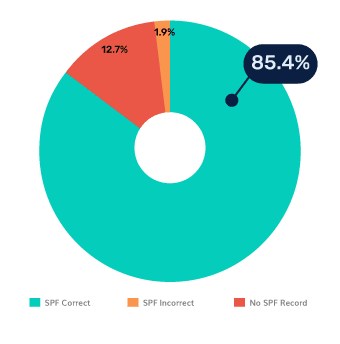
Rwanda-SPF

Strong SPF Foundation (85.4% Correct): Rwandan organizations demonstrate solid record discipline, with 85.4% of evaluated domains maintaining valid, syntactically correct SPF configurations. Only 1.9% exhibit configuration errors, though 12.7% still omit SPF records entirely.

Rwanda-DMARC

The Quarantine Plateau (35.7% at p=quarantine): In contrast to global trends where passive monitoring dominates, Rwanda exhibits a heavy concentration of domains paused at temporary enforcement rules. While three-quarters (75.0%) of domains publish a DMARC record, 35.7% are parked at p=quarantine, and 30.5% remain in passive observation (p=none). Only 8.5% enforce a strict, protective p=reject policy, while 25.0% omit DMARC completely.

Rwanda-MTA-STS

Total In-Transit Encryption Void (0.0% MTA-STS Adoption): Mail transfer agent transit security remains entirely unaddressed across the country. An absolute 100.0% of analyzed Rwandan domains lack valid MTA-STS records, leaving server-to-server email exchanges dependent solely on opportunistic STARTTLS and exposed to Man-in-the-Middle (MiTM) cleartext downgrade attacks.

Rwanda-DNSSEC

Marginal DNSSEC Routing Hardening (2.3% Enabled): Cryptographic DNS authentication remains virtually absent across the Rwandan domain perimeter. A critical 97.7% of domains lack DNSSEC signing, leaving domain resolution paths exposed to cache poisoning, spoofing, and unauthorized traffic redirection.

Sector-by-Sector Analysis

1. Financial Services (Banking): High Policy Containment with Zero Transit Hardening

Subject to stringent supervision under the NCSA Minimum Cybersecurity Standards for the Financial Sector and the National Bank of Rwanda (BNR), commercial banking institutions lead commercial containment, though full enforcement and transport security remain lagging.

Protocol Metric Current Status
SPF Accuracy 90.0% Correct (10.0% No Record)
DMARC Reject Policy 10.0% (p=reject)
DMARC Policies 50.0% Quarantine, 10.0% None
DMARC Gap 30.0% Missing Record
MTA-STS Adoption 0.0% Valid (100.0% Unsecured)
DNSSEC Adoption 0.0% Enabled (100.0% Disabled)
Banking-SPF-Adoption---Rwanda

Vulnerability Exposure

Commercial banks achieve a combined enforcement rate of 60.0%, driven by an overwhelming 50.0% concentration at p=quarantine. However, with 30.0% omitting DMARC and only 10.0% at p=reject, spoofed financial messages can still bypass defensive filters. Furthermore, the complete omission of MTA-STS (0.0%) and DNSSEC (0.0%) leaves interbank communications, wire authorizations, and customer statements exposed to network eavesdropping and domain spoofing.

The PowerDMARC Strategy

PowerDMARC enables commercial banks to advance from quarantine to full p=reject while deploying automated hosted MTA-STS and TLS-RPT telemetry, satisfying NCSA controls without disrupting transaction notices.

2. Healthcare: Prominent Quarantine Stance with Zero Rejection

Managing sensitive electronic health records and regional clinic data, Rwanda’s healthcare domain infrastructure demonstrates significant engagement with quarantine policies but complete absence of active rejection.

Protocol Metric Current Status
SPF Accuracy 91.1% Correct (8.9% No Record)
DMARC Reject Policy 0.0% (p=reject)
DMARC Policies 60.0% Quarantine, 11.1% None
DMARC Gap 26.7% Missing Record, 2.2% Incorrect
MTA-STS Adoption 0.0% Valid (100.0% Unsecured)
DNSSEC Adoption 0.0% Enabled (100.0% Disabled)
DMARC adoption Rwanda

Vulnerability Exposure

Healthcare records the highest proportion of quarantine configurations in the nation at 60.0%, paired with 91.1% SPF accuracy. However, with 0.0% active rejection (p=reject), spoofed clinical dispatches are merely flagged rather than outright blocked. Compounded by 0.0% MTA-STS and 0.0% DNSSEC, medical laboratories and healthcare portals remain exposed to patient data interception and unauthorized lookalike communications under Law Nº 058/2021.

The PowerDMARC Strategy

We guide healthcare operators through a structured transition to eliminate the quarantine plateau, implementing enforced rejection and automated transit encryption to safeguard patient confidentiality and public health networks.

3. Public Sector (Government): Near-Universal DMARC Adoption Stalled in Quarantine

Rwandan governmental ministries and administrative agencies showcase an exceptionally low missing record rate, reflecting strong central coordination by the NCSA and RISA, yet remain anchored in intermediate quarantine rules.

Protocol Metric Current Status
SPF Accuracy 94.3% Correct (2.9% Incorrect, 2.8% No Record)
DMARC Reject Policy 1.4% (p=reject)
DMARC Policies 61.4% Quarantine, 34.3% None
DMARC Gap 2.9% Missing Record (National Leader)
MTA-STS Adoption 0.0% Valid (100.0% Unsecured)
DNSSEC Adoption 0.0% Enabled (100.0% Disabled)
Government-MTA-STS-Adoption---Rwanda

Vulnerability Exposure

Public sector entities achieve the lowest DMARC omission rate in the nation, with only 2.9% lacking a record. An extraordinary 61.4% deploy p=quarantine alongside 34.3% at p=none. Nevertheless, with only 1.4% reaching p=reject and zero deployment of DNSSEC or MTA-STS, public portals remain vulnerable to civic impersonation, permit scams, and SMTP downgrade interception.

The PowerDMARC Strategy

Our multi-tenant portal for DMARC for government provides government IT administrators with centralized visibility to elevate departmental subdomains from quarantine to strict p=reject seamlessly.

4. Education: Sector Leader in Rejection Hardening Despite SPF Vulnerability

Rwandan higher education and research institutions present a unique dual profile: leading the country in strict DMARC enforcement while struggling with foundational SPF deployment.

Protocol Metric Current Status
SPF Accuracy 52.7% Correct (1.8% Incorrect, 45.5% No Record)
DMARC Reject Policy 32.7% (National Leader)
DMARC Policies 30.9% Quarantine, 18.2% None
DMARC Gap 18.2% Missing Record
MTA-STS Adoption 0.0% Valid (100.0% Unsecured)
DNSSEC Adoption 3.6% Enabled (96.4% Disabled)
Education-DNSSEC-Adoption---Rwanda

Vulnerability Exposure

Education is the national leader in active DMARC rejection, with 32.7% enforcing p=reject and 30.9% utilizing p=quarantine (a combined 63.6% enforcement rate). However, 45.5% of academic domains completely lack SPF records, leading to legitimate university correspondence being flagged as suspicious or discarded by external mailbox providers.

The PowerDMARC Strategy

Decoupled academic tools and external research platforms frequently trigger SPF validation failures. PowerDMARC solves SPF lookup exhaustion using PowerSPF flattening, pairing full enforcement with guaranteed outbound delivery.

5. Energy: High SPF Discipline Offset by Passive Observation

Rwanda’s national energy grid and utility providers maintain dependable foundational sender records, yet demonstrate a strong reliance on passive monitoring across domain authentication.

Protocol Metric Current Status
SPF Accuracy 97.0% Correct (National Leader, 1.5% Incorrect, 1.5% No Record)
DMARC Reject Policy 3.0% (p=reject)
DMARC Policies 15.1% Quarantine, 45.5% None
DMARC Gap 36.4% Missing Record
MTA-STS Adoption 0.0% Valid (100.0% Unsecured)
DNSSEC Adoption 3.0% Enabled (97.0% Disabled)
Energy-SPF-Adoption---Rwanda

Vulnerability Exposure

While energy providers achieve national leadership in SPF validity (97.0%), over 45% of domains remain stalled in passive observation (p=none), and 36.4% omit DMARC entirely. With only 3.0% at p=reject and non-existent transit encryption (0.0% MTA-STS), utility supply chains and smart-grid maintenance correspondence remain vulnerable to targeted executive impersonation and wire fraud.

The PowerDMARC Strategy

PowerDMARC enables critical utility infrastructure operators to comply with NCSA Essential Service Provider baselines by locking down domains with hosted MTA-STS and automated DMARC policy progression.

6. Media: Severe DMARC Void and Zero Active Defense

Rwandan news broadcasters, digital journals, and publication outlets carry significant civic influence, yet exhibit an alarming absence of protective email security.

Protocol Metric Current Status
SPF Accuracy 72.2% Correct (11.1% Incorrect, 16.7% No Record)
DMARC Reject Policy 0.0% (p=reject)
DMARC Policies 16.7% Quarantine, 33.3% None
DMARC Gap 50.0% Missing Record
MTA-STS Adoption 0.0% Valid (100.0% Unsecured)
DNSSEC Adoption 0.0% Enabled (100.0% Disabled)
Media-DMARC-Adoption---Rwanda

Vulnerability Exposure

Half (50.0%) of media organizations publish no DMARC record, and active rejection is entirely absent (0.0%). Coupled with an 11.1% SPF syntax error rate and 0.0% MTA-STS adoption, editorial teams and publishing portals are defenseless against brand spoofing, fake press dissemination, and credential theft.

The PowerDMARC Strategy

Deploying enforced DMARC alongside Brand Indicators for Message Identification (BIMI) allows reputable media outlets to project verified sender brand logos in subscriber inboxes, actively suppressing spoofed dispatches.

7. Telecommunications: Perfect SPF Accuracy and Leading DNSSEC Posture

Telecom operators and internet service providers manage high-throughput digital networks, displaying impeccable foundational SPF hygiene and leading DNSSEC adoption, though transport security remains unaddressed.

Protocol Metric Current Status
SPF Accuracy 100.0% Correct (Sector Leader)
DMARC Reject Policy 16.6% (p=reject)
DMARC Policies 0.0% Quarantine, 41.7% None
DMARC Gap 41.7% Missing Record
MTA-STS Adoption 0.0% Valid (100.0% Unsecured)
DNSSEC Adoption 16.7% Enabled (National Leader, 83.3% Disabled)
Telecom-MTA-STS-Adoption---Rwanda

Vulnerability Exposure

Telecom providers achieve a flawless 100.0% SPF validity rate and lead the country in DNSSEC implementation (16.7%). However, the sector exhibits a polarized DMARC posture: while 16.6% enforce p=reject, 41.7% remain in passive p=none observation, and 41.7% publish no record at all. Without MTA-STS (0.0%), carrier messaging gateways and automated customer billing notifications remain exposed to transit tampering.

The PowerDMARC Strategy

PowerDMARC provides telecommunications providers with granular reporting and automated record enforcement, eliminating spoofing threats across carrier subdomains without impacting message routing performance.

8. Transport & Logistics: Solid Baseline SPF Paired with Transport Interception Risks

Cross-border freight, regional logistics, and transit agencies support Rwanda’s trade integration, displaying dependable basic SPF configurations alongside notable enforcement gaps.

Protocol Metric Current Status
SPF Accuracy 90.6% Correct (9.4% No Record)
DMARC Reject Policy 6.3% (p=reject)
DMARC Policies 15.6% Quarantine, 40.6% None
DMARC Gap 37.5% Missing Record
MTA-STS Adoption 0.0% Valid (100.0% Unsecured)
DNSSEC Adoption 3.1% Enabled (96.9% Disabled)
DMARC adoption Rwanda

Vulnerability Exposure

Logistics operators display a modest 21.9% aggregate enforcement rate (p=reject at 6.3% and p=quarantine at 15.6%), while 40.6% remain parked at p=none and 37.5% omit DMARC. Coupled with 0.0% MTA-STS adoption, cross-border trade invoices, shipping notices, and customs documents remain vulnerable to fraudulent diversion and Man-in-the-Middle eavesdropping.

The PowerDMARC Strategy

We harden logistics communication channels with automated TLS enforcement and real-time failure telemetry via MTA-STS, protecting trade documentation and billing exchanges.

Sector-Level DMARC Adoption in Rwanda

% DMARC Adoption- Rwanda

%-DMARC-Adoption

Rwanda demonstrates strong baseline email security in critical sectors, led by Government, where 97.1% of domains have implemented DMARC policies and 62.8% actively enforce protection (⁠p=quarantine⁠ at 61.4% and ⁠p=reject⁠ at 1.4%). Education achieves the highest strict protection rate with 32.7% enforcing ⁠p=reject⁠, while Healthcare and Banking maintain high enforcement coverage at 60.0% combined (⁠p=quarantine⁠ + ⁠p=reject⁠). In contrast, Media lags behind with 50.0% of domains lacking any DMARC record, followed by Telecom at 41.7%. Across Energy, Transport, and Telecom, the primary vulnerability stems from domain owners remaining in monitoring mode (⁠p=none⁠), representing a key opportunity to transition existing records toward active rejection policies.

Deep Dive: Four Systemic Vulnerabilities in Rwandan Domains

1. The Quarantine Trap: Over-Reliance on Intermediate Filtering

A defining characteristic of Rwanda’s domain posture is the substantial concentration of domains stalled at p=quarantine (35.7% nationwide, including 61.4% in Government, 60.0% in Healthcare, and 50.0% in Banking). While quarantine routes fraudulent mail to spam folders, it fails to stop spoofed messages entirely and clutters users’ spam inboxes, leaving domain reputations vulnerable.

Expert insight:

“Quarantine is an essential transitional state, not a permanent defense. Stagnating at p=quarantine still allows unauthorized emails to penetrate receiving servers. Full protection against brand impersonation requires advancing to strict p=reject enforcement.”

DMARC adoption Rwanda

Maitham Al Lawati, CEO, PowerDMARC

Expert insight:

“Operating without MTA-STS leaves modern communication channels fundamentally exposed. In the absence of enforced MTA-STS, an adversary on the transit path can downgrade secure connections to cleartext. Enforced transport encryption is non-negotiable for preserving data privacy under Law Nº 058/2021.”

DMARC adoption Rwanda

Yunes Tarada, Service Delivery Manager, PowerDMARC

2. The Nationwide MTA-STS Void: Universal Cleartext Transit Exposure

With 0.0% of Rwandan domains across every analyzed sector deploying MTA-STS, national email delivery depends entirely on opportunistic STARTTLS encryption. Malicious network intermediaries can exploit this vulnerability through SSL-stripping and downgrade attacks, intercepting sensitive emails in unencrypted format without triggering security alerts.

3. DNSSEC Non-Deployment: Vulnerabilities at the Sovereign Routing Layer

An overwhelming 97.7% of evaluated Rwandan domains omit DNSSEC signing. This creates widespread exposure to DNS cache-poisoning and forged lookup responses, enabling attackers to covertly intercept traffic or redirect mail delivery without tampering with the originating servers.

Expert insight:

“If the DNS resolution layer lacks cryptographic validation, downstream authentication mechanisms are compromised. DNSSEC provides the cryptographic guarantee verifying that receiving systems are communicating with legitimate name servers rather than malicious lookalikes.”

DMARC adoption Rwanda

Ayan Bhuiya, Operations & Delivery Shift Lead, PowerDMARC

Expert insight:

“Cloud service proliferation makes SPF lookup exhaustion an inevitable hurdle for expanding enterprises. Implementing automated SPF flattening is essential to compress records dynamically, avoid syntax errors, and protect outbound message deliverability.”

DMARC adoption Rwanda

Engjell Koliqi, Marketing Manager, PowerDMARC

4. SPF lookup Boundaries and Configuration Omissions

While baseline SPF validity is high in utilities and telecom, key sectors like Education display alarming gaps (45.5% omitting SPF). Furthermore, as enterprises adopt cloud-hosted applications, records frequently breach the strict 10-DNS lookup limit, causing evaluation timeouts and legitimate delivery failures.

Global Benchmarking: Rwanda in Context

Evaluating Rwanda’s authentication posture against international benchmarks reveals a nation with strong foundational adoption and high quarantine engagement, but clear opportunities to accelerate full enforcement and transit cryptography.

The Global Leaderboard: 2026 Comparative Data

Country SPF Correct DMARC Reject MTA-STS Valid DNSSEC Enabled
Denmark 96.8% 57.6% 3.0% 65.8%
USA 95.7% 49.0% 1.7% 18.0%
UK 93.7% 44.1% 20.6% 3.8%
France 95.6% 28.3% 2.6% 17.9%
Ecuador 96.1% 24.9% 1.4% 4.8%
Netherlands 70.0% 23.2% 0.9% 37.7%
Poland 98.9% 21.2% 0.9% 15.7%
Brazil 92.1% 20.7% 0.7% 21.9%
Austria 97.0% 19.7% 1.9% 7.1%
Romania 97.1% 17.3% 1.8% 7.0%
Switzerland 96.0% 16.8% 4.4% 32.6%
Italy 91.0% 16.7% 1.0% 3.5%
Ghana 86.0% 9.1% 0.9% 3.9%
Rwanda 85.4% 8.5% 0.0% 2.3%

Rwanda in the Global Spotlight: 2026 Analysis

1
Enforcement Posture

Rwanda’s 8.5% p=reject rate sits close to regional peer Ghana (9.1%), but trails Southern European benchmarks like Italy (16.7%) and leaders like Denmark (57.6%). However, when factoring in quarantine policies (35.7%), Rwanda’s combined enforcement (44.2%) substantially surpasses many emerging markets, demonstrating that the foundation for strict rejection is already operational.

2
Transit Cryptography

With 0.0% MTA-STS deployment, Rwanda lags behind both regional peers like Ghana (0.9%) and global transit security leaders like the UK (20.6%) and Switzerland (4.4%), representing the most urgent protocol upgrade opportunity nationwide.

3
DNSSEC Standing

At 2.3% DNSSEC deployment, Rwanda performs slightly below Ghana (3.9%) and Italy (3.5%), underscoring the necessity of signing sovereign domain zones at the top-level registry.

The PowerDMARC Viewpoint

“Rwanda has established an enviable foundation for digital governance under the leadership of the National Cyber Security Authority. The nationwide presence of DMARC records and remarkable quarantine adoption demonstrate that organizations understand authentication concepts. The critical imperative now is finalizing this journey: advancing domains from quarantine to automated rejection, deploying MTA-STS to secure in-flight communications, and securing the DNS perimeter to establish end-to-end digital resilience across Rwanda’s digital economy.”

Strategic Roadmap: Transitioning to Active Protection

To address systemic vulnerabilities and fulfill NCSA Essential Service Provider requirements, Rwandan organizations should execute three operational priorities:

Advance from Quarantine to Enforced Rejection (p=reject)

Migrate organizational domains currently parked at p=quarantine (35.7%) and p=none (30.5%) to full p=reject, ensuring that unauthorized messages abusing Rwandan brands are actively discarded.

Deploy Hosted MTA-STS and TLS-RPT Protocols

Eliminate nationwide transit eavesdropping vulnerabilities by implementing automated hosted MTA-STS and TLS reporting telemetry, guaranteeing encrypted server-to-server email transport across domestic and international exchanges.

Automate Dynamic SPF Flattening

Resolve cloud lookup limits and eliminate record errors using automated SPF flattening (PowerSPF), ensuring that authentic institutional correspondence is reliably delivered without SPF evaluation timeouts.

Methodology, Research & Data Sources

DNS Record Analysis

Automated DNS interrogation operations were executed across Rwandan organizational and public domain perimeters, assessing SPF, DMARC, MTA-STS, and DNSSEC records against established IETF RFC standards.

Sector Sampling

Evaluations encompassed eight essential sectors underpinning Rwanda's economic infrastructure:

  • Banking (Financial Services)
  • Healthcare
  • Public Sector (Government)
  • Education
  • Energy
  • Media
  • Telecommunications
  • Transport & Logistics

Risk Classification

Security posture assessments evaluate the distribution of domains enforcing active p=reject policies, DMARC omission rates, SPF syntax validity, and implementation rates of MTA-STS and DNSSEC.

Transforming Rwandan Domain Visibility into Active Defense

Rwanda’s vision of becoming a continental digital hub requires secure, verifiable electronic communications. By transitioning from passive monitoring and quarantine holdovers to automated, enforced defense, Rwandan enterprises and state bodies can protect their brands and safeguard national critical infrastructure. Contact PowerDMARC today to evaluate, automate, and harden your organization’s email authentication posture.