
Denmark DMARC & MTA-STS Adoption Report 2026

Operating within one of the world’s most digitized economies, Danish commercial enterprises, state bodies, and critical utility networks navigate a sophisticated threat landscape. While Denmark demonstrates remarkable European leadership in active DMARC enforcement and DNSSEC cryptosecurity, driven by early public-sector mandates from the Center for Cyber Security (Center for Cybersikkerhed – CFCS) and the Danish Agency for Digital Government (Digitaliseringsstyrelsen – DIGST), critical transit vulnerabilities persist across inbound server pathways. Under Denmark’s national NIS2 regulatory framework and supervision coordinated by the Danish Civil Contingency Agency (Styrelsen for Samfundssikkerhed), closing residual monitoring gaps and eliminating SMTP cleartext transit exposures via MTA-STS is paramount to defending corporate reputations, ensuring uninterrupted global mailbox delivery, and fulfilling statutory resilience obligations.
At a Glance: Key Findings Across Denmark

Our national assessment across Danish digital domain assets illustrates exceptional technical discipline and enforcement leadership, coupled with a systemic blind spot in transport-layer cryptography:

denmark-spf

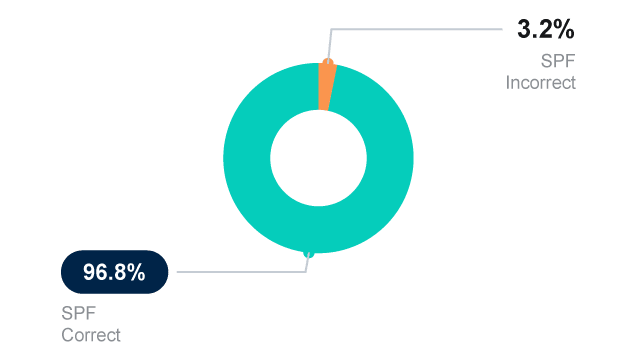
SPF Baseline Discipline (96.8% Correct): Danish organizations maintain strong DNS record hygiene, with 96.8% publishing syntactically valid SPF records and only 3.2% exhibiting record formatting errors, multiple records, or syntax flaws.

denmark-dmarc

European-Leading DMARC Enforcement (57.6% at p=reject): Denmark outpaces all surveyed European peers in active email defense. A remarkable 57.6% of analyzed Danish domains actively block spoofed messages with a strict p=reject policy. Combined with p=quarantine (12.9%), total enforcement reaches 70.5%. Only 18.6% linger in passive observation (p=none), 0.4% contain syntax errors, and a mere 10.5% omit DMARC completely.

Denmark DMARC adoption

Persistent MTA-STS In-Transit Deficit (97.0% Unsecured): Despite world-class domain authentication, server-to-server transit encryption remains severely lagging. A substantial 97.0% of Danish domains have yet to configure MTA-STS, leaving SMTP connections vulnerable to Man-in-the-Middle (MiTM) TLS downgrade interception, with only 3.0% having deployed active transit protection.

denmark-dnssec

Pioneering DNSSEC Integrity (65.8% Enabled): In stark contrast to wider European trends, Denmark demonstrates exceptional cryptographic routing protection. Bolstered by widespread registrar support and state technical standards, 65.8% of Danish domains have activated DNSSEC, shielding the majority of the nation’s traffic from cache-poisoning and resolver tampering.

Sector-by-Sector Analysis

1. Financial Services (Banking): Market-Leading Private Enforcement and Strong Cryptography

Governed by strict supervisory standards from the Danish Financial Supervisory Authority (Finanstilsynet) and early compliance with DORA and sector resilience statutes, Danish banks lead the commercial sector with overwhelming active enforcement.

Protocol Metric Current Status
SPF Accuracy 98.8% Correct (1.2% Incorrect)
DMARC Reject Policy 80.5% (p=reject)
DMARC Policies 11.0% Quarantine, 6.1% None
DMARC Gap 1.2% Missing Record, 1.2% Incorrect
MTA-STS Adoption 6.1% Valid (93.9% Unsecured)
DNSSEC Adoption 61.0% Enabled (39.0% Disabled)
Denmark DMARC adoption

Vulnerability Exposure

Banking displays remarkable defensive cohesion, achieving an aggregate 91.5% enforcement rate (p=reject at 80.5% and p=quarantine at 11.0%) with only 1.2% omitting DMARC. Furthermore, 61.0% of banking domains are protected by DNSSEC. However, 93.9% still lack MTA-STS policies, allowing adversaries positioned along external internet routing channels to strip opportunistic TLS encryption during cross-border wire and transaction messaging.

The PowerDMARC Strategy

PowerDMARC enables financial institutions to close the final transit gap via hosted MTA-STS and automated TLS-RPT telemetry, safeguarding transactional communications against eavesdropping without administrative overhead.

2. Healthcare: Solid Policy Enforcement with Significant DNSSEC Deployment

Danish regional healthcare entities and life sciences organizations manage highly confidential patient and research records, exhibiting robust enforcement compared to international healthcare counterparts.

Protocol Metric Current Status
SPF Accuracy 94.1% Correct (5.9% Incorrect)
DMARC Reject Policy 41.6% (p=reject)
DMARC Policies 20.8% Quarantine, 24.7% None
DMARC Gap 12.9% Missing Record
MTA-STS Adoption 3.0% Valid (97.0% Unsecured)
DNSSEC Adoption 60.4% Enabled (39.6% Disabled)
Healthcare-dmarc-denmark

Vulnerability Exposure

Danish healthcare achieves a combined 62.4% enforcement posture and 60.4% DNSSEC deployment. Nonetheless, nearly a quarter (24.7%) of healthcare domains remain parked in monitor-only mode (p=none), and 12.9% lack DMARC records entirely. Coupled with a 97.0% MTA-STS omission rate, patient-facing alerts and supplier portals remain exposed to spoofing and transport tampering.

The PowerDMARC Strategy

We help healthcare providers and regional medical bodies migrate their remaining passive domains smoothly to p=reject, shielding patient trust and securing sensitive medical dispatch channels.

3. Public Sector (Government): Near-Universal Compliance and Sovereign Integrity

Danish national, regional, and municipal authorities represent the global gold standard in public-sector domain hardening, reflecting strict adherence to CFCS directives and official government cybersecurity guidance.

Protocol Metric Current Status
SPF Accuracy 98.6% Correct (1.4% Incorrect)
DMARC Reject Policy 93.2% (National Leader)
DMARC Policies 2.7% Quarantine, 1.4% None
DMARC Gap 2.7% Missing Record
MTA-STS Adoption 4.1% Valid (95.9% Unsecured)
DNSSEC Adoption 93.2% Enabled (National Leader, 6.8% Disabled)
Public-Sector-mta-sts-denmark

Vulnerability Exposure

Spurred by official guidance requiring p=reject across government infrastructure, Danish civic bodies achieve an astonishing 95.9% total enforcement (p=reject at 93.2%), paired with an identical 93.2% DNSSEC adoption rate. Only 2.7% lack DMARC. The remaining opportunity for state hardening lies in transport security, where 95.9% of agencies still operate without enforced MTA-STS policies.

The PowerDMARC Strategy

PowerDMARC’s multi-tenant DMARC for government platform allows centralized government IT teams to manage subdomains, enforce MTA-STS across ministerial networks, and monitor mail ecosystem health from a single pane of glass.

4. Education: Perfect SPF Accuracy and Majority Enforcement

Higher education institutions and academic consortia oversee extensive digital campuses, demonstrating flawless basic record configuration alongside strong enforcement metrics.

Protocol Metric Current Status
SPF Accuracy 100.0% Correct (0.0% Incorrect)
DMARC Reject Policy 51.7% (p=reject)
DMARC Policies 13.8% Quarantine, 17.2% None
DMARC Gap 13.8% Missing Record, 3.5% Incorrect
MTA-STS Adoption 0.0% Valid (100.0% Unsecured)
DNSSEC Adoption 58.6% Enabled (41.4% Disabled)
education-dnssec-denmark

Vulnerability Exposure

Danish universities achieve 100.0% SPF validity and a solid 51.7% p=reject rate. However, 17.2% of academic institutions linger at p=none, 13.8% lack DMARC, and 3.5% contain syntax errors. Crucially, the sector exhibits 0.0% MTA-STS adoption, leaving university credentials, research

The PowerDMARC Strategy

Multi-vendor academic ecosystems frequently exceed the hard 10-DNS lookup limit due to decentralized SaaS tools. PowerSPF flattening dynamically condenses records to prevent lookup errors and maintain high outbound deliverability.

5. Energy: Resilient Critical Infrastructure with Robust DNSSEC

Covered under the specialized Act on Security and Preparedness in the Energy Sector (Act No. 258/2025), Danish power grid and offshore wind operators demonstrate high defensive maturity.

Protocol Metric Current Status
SPF Accuracy 96.5% Correct (3.5% Incorrect)
DMARC Reject Policy 54.6% (p=reject)
DMARC Policies 10.5% Quarantine, 20.9% None
DMARC Gap 14.0% Missing Record
MTA-STS Adoption 2.3% Valid (97.7% Unsecured)
DNSSEC Adoption 65.1% Enabled (34.9% Disabled)
energy-spf-denmark

Vulnerability Exposure

Energy operators record a robust 65.1% combined DMARC enforcement rate and 65.1% DNSSEC deployment, significantly outperforming broader European utility benchmarks. Nonetheless, 20.9% remain at p=none, and 14.0% have no DMARC record. Furthermore, with 97.7% lacking MTA-STS, critical utility dispatch and supply-chain procurement communications remain susceptible to transit interception.

The PowerDMARC Strategy

We combine automated hosted MTA-STS with policy enforcement controls to shield energy suppliers and grid operators from targeted executive spoofing and transport manipulation.

6. Media: Robust Infrastructure with Residual Monitoring Exposure

Danish broadcast and print news organizations enjoy significant public credibility, maintaining commendable baseline security alongside an over-reliance on passive monitoring.

Protocol Metric Current Status
SPF Accuracy 93.1% Correct (6.9% Incorrect)
DMARC Reject Policy 37.5% (p=reject)
DMARC Policies 15.3% Quarantine, 33.3% None
DMARC Gap 13.9% Missing Record
MTA-STS Adoption 1.4% Valid (98.6% Unsecured)
DNSSEC Adoption 61.1% Enabled (38.9% Disabled)
media-dmarc-denmark

Vulnerability Exposure

While 61.1% of media domains have enabled DNSSEC, 33.3% remain parked at p=none, and 13.9% omit DMARC entirely. Combined with a 1.4% MTA-STS deployment rate, news outlets face potential brand hijacking where threat actors can circulate falsified press releases or malicious media notices using unverified subdomains.

The PowerDMARC Strategy

Implementing Brand Indicators for Message Identification (BIMI) alongside enforced DMARC policies empowers media organizations to project verified brand trust in user inboxes while neutralizing impersonation vectors.

7. Telecommunications: Strong Base Infrastructure, Total In-Transit Void

Regulated under the Act on Security and Preparedness in the Telecommunications Sector (Act No. 435/2025), Danish carriers maintain complex network routing with notable policy adoption.

Protocol Metric Current Status
SPF Accuracy 98.2% Correct (1.8% Incorrect)
DMARC Reject Policy 46.4% (p=reject)
DMARC Policies 10.7% Quarantine, 25.0% None
DMARC Gap 17.9% Missing Record
MTA-STS Adoption 0.0% Valid (100.0% Unsecured)
DNSSEC Adoption 58.9% Enabled (41.1% Disabled)
telecom-mta-sts-denmark

Vulnerability Exposure

Telecommunications achieves 57.1% aggregate enforcement and 58.9% DNSSEC enablement. However, 17.9% of telecom domains lack DMARC, a quarter (25.0%) sit at p=none, and the sector exhibits 0.0% MTA-STS adoption. This creates clear opportunities for adversaries to target subscribers with fraudulent SMS/email billing notices and intercept plaintext gateway exchanges.

The PowerDMARC Strategy

PowerDMARC provides carrier-grade SPF and DMARC management, allowing telco operators to achieve strict p=reject enforcement across complex subsidiary domains without disrupting customer-bound notifications.

8. Transport & Logistics: Flawless SPF, Leading National Transit Security

Danish maritime, freight, and transport enterprises support crucial global supply chains, demonstrating spotless SPF hygiene and Denmark’s highest MTA-STS deployment.

Protocol Metric Current Status
SPF Accuracy 100.0% Correct (0.0% Incorrect)
DMARC Reject Policy 42.3% (p=reject)
DMARC Policies 23.1% Quarantine, 23.1% None
DMARC Gap 11.5% Missing Record
MTA-STS Adoption 7.7% Valid (National Leader, 92.3% Unsecured)
DNSSEC Adoption 61.5% Enabled (38.5% Disabled)
Denmark DMARC adoption

Vulnerability Exposure

The transport sector records 100.0% SPF validity, 65.4% total DMARC enforcement, and leads Denmark in MTA-STS deployment (7.7%). However, with 23.1% of operators still using p=none and 11.5% lacking records, international trade partners and freight billing streams remain vulnerable to invoice diversion fraud.

The PowerDMARC Strategy

We equip logistics enterprises with automated TLS encryption and real-time sender intelligence via MTA-STS, ensuring electronic bills of lading and shipment invoices are cryptographically validated before inbox delivery.

Deep Dive: Four Systemic Vulnerabilities in Danish Domains

1. The Observation Drag: Residual Exposure in Non-Enforced Segments

While Denmark leads Europe with 57.6% p=reject enforcement, nearly a fifth (18.6%) of organizational domains remain stalled at p=none. Treating passive monitoring as a permanent configuration leaves domains entirely unprotected against active impersonation; malicious spoofed emails continue to land directly in target inboxes.

Expert insight:

“Denmark has set an inspiring standard for active enforcement across Europe, but leaving nearly twenty percent of domains in passive observation creates a persistent backdoor. Monitoring gives you visibility, but only strict p=reject policies stop domain abuse.”

Denmark DMARC adoption

Maitham Al Lawati, CEO, PowerDMARC

Expert insight:

“In digitally advanced environments like Denmark, SPF lookup limit breaches are almost unavoidable without automation. Implementing dynamic SPF flattening compresses record lookups programmatically, eliminating deliverability failures and keeping critical outbound channels healthy.”

Denmark DMARC adoption

Yunes Tarada, Service Delivery Manager, PowerDMARC

2. SPF Lookup Exhaustion in Highly Digitalized Enterprise Stacks

Denmark’s rapid cloud adoption means enterprises rely heavily on multiple SaaS tools (Salesforce, Microsoft 365, Zendesk, Workday). This frequently causes SPF records to exceed the strict 10-DNS lookup limit stipulated by RFC 7208. Exceeding this limit results in PermError failures, causing legitimate outgoing business communications to be dropped or sent to spam folders.

3. MTA-STS: The Final Frontier in Danish Mail Encryption

With 97.0% of Danish domains lacking MTA-STS validation, inbound mail routing relies primarily on opportunistic STARTTLS. This allows malicious actors on network routes to carry out SSL-stripping and Man-in-the-Middle (MiTM) downgrade attacks, intercepting cleartext communications and altering sensitive corporate messages in transit.

Expert insight:

“Opportunistic encryption is not a robust defensive posture. Without enforced MTA-STS policies, adversaries can silently downgrade encrypted connections to cleartext. Enforced transport-layer security is essential for end-to-end data confidentiality.”

Denmark DMARC adoption

Ayan Bhuiya, Operations & Delivery Shift Lead, PowerDMARC

Expert insight:

“Denmark’s DNSSEC adoption is among the strongest in the world. However, downstream security protocols rely entirely on DNS integrity. Ensuring 100% cryptographic validation across all root and sub-domains is critical to eliminating routing hijacking.”

Denmark DMARC adoption

Engjell Koliqi, Marketing Manager, PowerDMARC

4. DNSSEC Maturity: A Danish Success Story with Remaining Gaps

Denmark stands out globally with 65.8% DNSSEC enablement, driven by the proactive policies of the national .dk registry and state technical directives. However, the remaining 34.2% of unconfigured domains remain susceptible to DNS spoofing and DNS cache-poisoning, creating trust gaps that can undermine downstream authentication.

Global Benchmarking: Denmark in Context

Denmark’s aggressive policy enforcement and mature DNSSEC implementation position the country as an international benchmark, outperforming the majority of European and global economies in active domain protection.

The Global Leaderboard: 2026 Comparative Data

Country SPF Correct DMARC Reject MTA-STS Valid DNSSEC Enabled
Denmark 96.8% 57.6% 3.0% 65.8%
USA 95.7% 49.0% 1.7% 18.0%
UK 93.7% 44.1% 20.6% 3.8%
France 95.6% 28.3% 2.6% 17.9%
Netherlands 70.0% 23.2% 0.9% 37.7%
Poland 98.9% 21.2% 0.9% 15.7%
Austria 97.0% 19.7% 1.9% 7.1%
Spain 97.0% 18.0% 0.8% 10.4%
Romania 97.1% 17.3% 1.8% 7.0%
Switzerland 96.0% 16.8% 4.4% 32.6%
Italy 91.0% 16.7% 1.0% 3.5%
Brazil 92.1% 20.7% 0.7% 21.9%
Ecuador 96.1% 24.9% 1.4% 4.8%

Denmark in the Global Spotlight: 2026 Analysis

1
Enforcement Supremacy

Denmark leads the global leaderboard with a 57.6% p=reject rate, surpassing the United States (49.0%), the United Kingdom (44.1%), France (28.3%), Austria (19.7%), and Switzerland (16.8%).

2
DNSSEC Dominance

At 65.8% enabled, Denmark ranks highest worldwide in cryptographic DNS protection among surveyed markets, nearly doubling the Netherlands (37.7%) and Switzerland (32.6%), and far exceeding Austria (7.1%) and Romania (7.0%).

3
MTA-STS Compliance

 Denmark’s 3.0% MTA-STS adoption rate exceeds the majority of European peers, including France (2.6%), Austria (1.9%), Romania (1.8%), and Italy (1.0%), trailing only Switzerland (4.4%) and the UK (20.6%).

The PowerDMARC Viewpoint

“Denmark stands as a premier example of how coordinated public policy, aggressive public-sector mandates, and registrar leadership can elevate a country’s national cybersecurity posture. With public administration achieving over 93% active rejection, the private sector has followed suit with impressive maturity. The final frontier for Danish organizations is eliminating the in-transit eavesdropping risk by establishing hosted MTA-STS as standard operating procedure across all economic sectors.”

Strategic Roadmap: Transitioning to Active Protection

To sustain digital resilience and achieve full alignment with Danish NIS2 regulations, organizations should follow three technical milestones:

Advance Remaining Domains to Full Enforcement (p=reject)

Systematically transition the remaining 18.6% of passive domains from p=none through p=quarantine to p=reject, neutralizing impersonation without disrupting operational business communications.

Implement Hosted MTA-STS & TLS-RPT

Protect SMTP pathways against TLS downgrade attacks by automating certificate renewal and policy publishing through hosted MTA-STS, gaining complete visibility via TLS reporting telemetry.

Automate SPF Dynamic Optimization

Implement automated SPF flattening (PowerSPF) to prevent DNS lookup threshold overages, preserving deliverability across multi-vendor cloud software stacks.

Methodology, Research & Data Sources

DNS Record Analysis

Automated DNS queries were performed across Danish domain repositories, benchmarking SPF, DMARC, MTA-STS, and DNSSEC configurations against official IETF RFC specifications.

Sector Sampling

Domains were analyzed across eight critical economic and public sectors in Denmark:

  • Banking (Financial Services)
  • Healthcare
  • Public Sector (Government)
  • Education
  • Energy
  • Media
  • Telecommunications
  • Transport & Logistics

Risk Classification

Posture evaluations measure the proportion of domains operating under enforced p=reject policies, DMARC omission rates, SPF configuration accuracy, and deployment rates of MTA-STS and DNSSEC.

Transforming Danish Domain Visibility into Active Defense

Danish enterprises and state institutions have set a formidable benchmark in domain authentication. Hardening these communication channels against remaining transit vulnerabilities requires pairing enforced DMARC with automated transport security. Contact PowerDMARC today to benchmark, automate, and complete your organization’s domain defenses.