Mexico DMARC & MTA-STS Adoption Report 2026

Alarmingly, research on regional threat landscapes reveals that Mexico faces an immense volume of attacks, trailing only Brazil as the second-most targeted market in Latin America. In fact, specific corporate risk data highlights that 43% of cyberattacks launched against organizations in Mexico successfully breach their perimeter, requiring teams to heavily rely on after-the-fact remediation rather than proactive prevention. 

Furthermore, deep-dive threat reports indicate that ransomware pressures remain historically high across the country; during intense peak cycles, an overwhelming 74% of analyzed Mexican organizations suffered a successful ransomware attack within a single 12-month period.
At a Glance: Key Findings Across Mexico

Mexico SPF

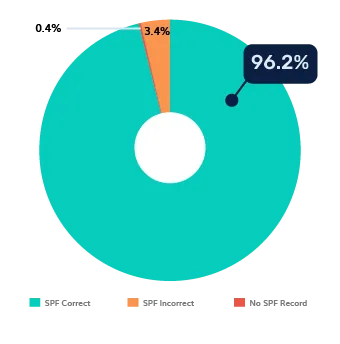
SPF: 96.2% correct – IT departments across the country demonstrate exceptional technical accuracy in configuring sender validation.

Mexico DMARC

DMARC: A concerning defensive gap remains, with 21.9% of analyzed domains completely unprotected by DMARC and only 16.2% reaching maximum reject enforcement.

Mexico MTA-STS

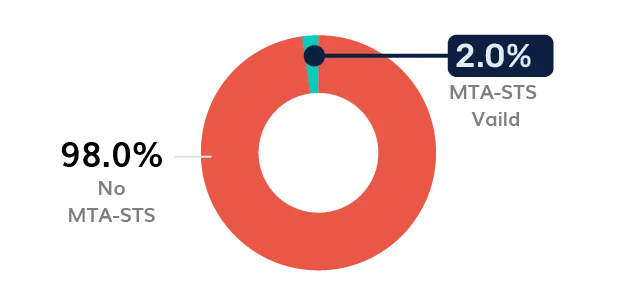
MTA-STS: Transport-layer encryption remains virtually non-existent at 99.6% non-adoption, exposing email traffic to network-level eavesdropping.

DNSSEC: Enabled on 9.9% of domains, indicating a gradual crawl toward domain security, though 90.1% remain exposed to cache poisoning and malicious rerouting.

Sector-by-Sector Analysis

1. Financial: Advanced Target, Weakened Encryption

As the engine of the national economy, Mexican financial services push hard on email authentication rules, yet their transport paths remain heavily exposed.

Metric Status
SPF 97.1% correct
DMARC Reject 29.1% (Sector Leader)
DMARC Gap 14.6% have no record
MTA-STS 1.0% valid
DNSSEC 10.7% enabled
Banking SPF Adoption - Mexico

Threat Scenario

With 99.0% of financial domains neglecting transport security, message streams between regional hubs move without hard cryptographic enforcement. Threat actors use “Downgrade Attacks” to strip out basic encryption layers, intercepting wire confirmations to rewrite recipient parameters and skim massive liquidity reserves undetected.

The PowerDMARC Solution

PowerDMARC seals the transport channel with Hosted MTA-STS, mandating TLS 1.2+ encryption for all incoming mail, suppressing Man-in-the-Middle (MiTM) interference and locking down interbank inbound messages.

2. Healthcare: Low Enforcement, High Exposure

Ecosystems handling vital medical and proprietary clinical data run on some of the weakest authentication rules in Mexico.

Metric Status
SPF 97.2% correct
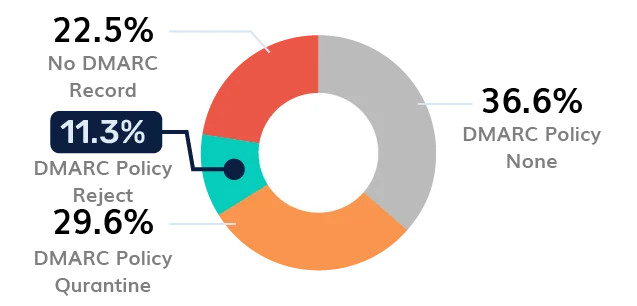
DMARC Reject 11.3%
DMARC Gap 22.5% lack DMARC entirely
MTA-STS 0.0% adoption
DNSSEC 14.1% enabled
Healthcare DMARC Adoption - Mexico

Threat Scenario

Because nearly a quarter of healthcare domains lack DMARC records entirely, hackers can seamlessly forge hospital identities. Forged emails carrying malicious “Diagnostic Software Updates” are sent directly to internal administrative teams, leading to network-wide ransomware deployment that freezes clinical operations.

The PowerDMARC Solution

PowerDMARC provides a clear, monitored migration path from zero domain protection up to an active p=reject barrier, neutralising phishing campaigns before they ever touch hospital personnel.

Government: Solid Infrastructure, Idle Protection

Public sector entities command immense trust, yet their widespread reliance on soft “monitoring-only” rules leaves them open to manipulation.

Metric Status
SPF 96.5% correct
DMARC Reject 19.0%
DMARC Policy 33.6% at “quarantine”
MTA-STS 0.0% adoption
DNSSEC 10.3% enabled

Threat Scenario

With 33.6% of state-level domains locked at quarantine, cloned government warnings still pass through network filters and sit in user spam folders. During high-visibility public events, threat actors can weaponize these folders, counting on citizens checking spam to manipulate public behavior via fraudulent directives.

The PowerDMARC Solution

Our unified multi-tenant dashboard gives oversight agencies a single control point to secure extensive subdomain networks, safely accelerating the push to an enforced reject posture.

4. Education: Decentralized Academic Infiltration

Higher education networks hold valuable intellectual property and student data, but remain behind on defensive deployment.

Metric Status
SPF 92.8% correct
DMARC Reject 14.5%
DMARC Policy 31.9% at “quarantine”
MTA-STS 0.0% adoption
DNSSEC 13.0% enabled

Threat Scenario

Attackers take advantage of low enforcement rates to clone university domains, delivering fake administrative prompts to faculty members. These malicious emails harvest credentials to compromise internal databases and steal proprietary academic research.

The PowerDMARC Solution

Academic systems regularly break the standard 10-DNS lookup ceiling due to a mix of departmental cloud services. PowerSPF compresses these configurations, ensuring that critical educational communication is never blocked by protocol errors.

5. Energy: Supply Chain Vulnerabilities

Industrial and energy assets show strong technical accuracy but allow vulnerabilities to build at the supplier perimeter.

Metric Status
SPF 96.0% correct
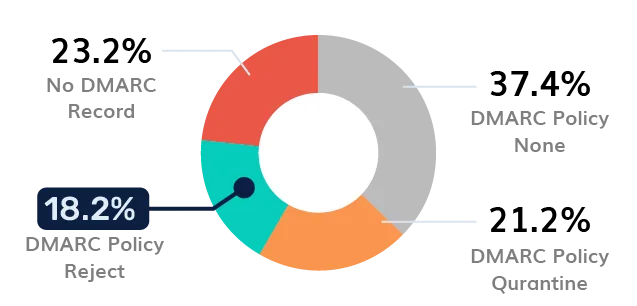
DMARC Reject 18.2%
DMARC Gap 23.2% lack DMARC entirely
MTA-STS 1.0% valid
DNSSEC 9.1% enabled

Threat Scenario

Since 23.2% of energy entities fail to publish DMARC records, threat actors can easily impersonate component manufacturers. They use spoofed domains to distribute fake maintenance invoices or corrupt firmware links, looking to jump from business email environments into operational machinery controls.

The PowerDMARC Solution

PowerDMARC bridges DMARC enforcement with hosted MTA-STS protocols, validating sender origins while ensuring all data packets in transit remain thoroughly encrypted.

6. Media: Information Integrity Vulnerabilities

Highly visible media operations remain vulnerable, where weak validation metrics let bad actors exploit public credibility.

Metric Status
SPF 97.8% correct
DMARC Reject 5.2% (Sector Low)
DMARC Gap 31.1% have no record
MTA-STS 0.0% adoption
DNSSEC 7.4% enabled
Media DMARC Adoption - Mexico

Threat Scenario

A massive 31.1% DMARC gap means that anyone can impersonate a primary media outlet. Bad actors use this gap to blast forged breaking-news alerts to corporate boards or regulatory agencies, aiming to manipulate stock prices or trigger panic.

The PowerDMARC Solution

We help organizations implement Brand Indicators for Message Identification (BIMI), placing authenticated corporate logos inside consumer inboxes to provide an immediate visual stamp of validity.

7. Telecommunications: High Quarantine Dependency

Telecom providers form the backbone of Mexico’s digital networks, yet their passive posture puts millions of subscribers at risk.

Metric Status
SPF 93.9% correct
DMARC Reject 22.4%
DMARC Policy 30.6% at “quarantine”
MTA-STS 2.0% valid
DNSSEC 4.1% enabled (Sector Low)
BIMI Logo

Threat Scenario

Scammers clone telecom domains to send urgent, look-alike “Billing Error” alerts to users. Because nearly a third of carrier domains rely on a passive quarantine setting, these emails routinely land where subscribers can see them, leading to credential harvesting and eventual phone line hijackings.

The PowerDMARC Solution

PowerDMARC helps organizations deploy DMARC p=reject across all communication subdomains, making it impossible for threat actors to use the company’s own brand identity against its clients.

8. Transport: Trade and Logistics Exposure

Logistics and supply-chain operations handle rapid data exchanges where any disruption can derail critical trading pipelines.

Metric Status
SPF 95.2% correct
DMARC Reject 9.5%
DMARC Gap 28.6% lack DMARC entirely
MTA-STS 0.0% adoption
DNSSEC 11.9% enabled
Transport DNSSEC Adoption - Mexico

Threat Scenario

A significant 28.6% of transport domains fail to leverage DMARC protections. Scammers forge commercial shipping headers to send modified freight manifest updates to port authorities and tracking partners, diverting high-value cargo shipments into fraudulent transit networks.

The PowerDMARC Solution

PowerDMARC secures multi-partner trade routes by confirming that every outbound automated update, invoice, and bill of lading is completely verified before it reaches an external gateway.

Under the Hood: Four Structural Weaknesses

1. The “Compliance Trap” of p=none

A high percentage of Mexican businesses publish a basic DMARC footprint but stall at a passive p=none status (representing 34.9% of the nation’s records). This provides broad oversight visibility but does absolutely nothing to stop an active domain forgery attack.

Expert insight:

“Organizations frequently mistake visibility for safety. While setting up a basic record is an important starting step, the domain remains open to exploitation until the policy is actively upgraded to ‘reject’. Real protection requires moving past monitoring and turning on automated defense at the security gateway.”

Maitham Al Lawati, CEO, PowerDMARC

Expert insight:

“Modern business networks rely on massive, distributed software stacks that quickly overload legacy SPF lookup limits. Applying automated SPF Flattening is no longer just a cleaning exercise – it is essential to maintaining operational delivery and brand legitimacy.”

Yunes Tarada, Service Delivery Manager, PowerDMARC

2. SPF Complexity and the 10-Lookup Limit

As Mexican commercial networks deploy complex cloud ecosystems for operations, marketing, and HR, their SPF structures routinely break the standard 10-DNS-lookup limit. This causes legitimate business emails to fail automated checks and get dropped into recipient spam filters.

3. MTA-STS: The Encryption Blind Spot

With 99.6% of Mexican domains lacking MTA-STS protocols, email servers depend entirely on opportunistic encryption. This leaves the data open to downgrade attacks where traffic is stripped into readable plaintext.

Expert insight:

“Relying on simple, opportunistic encryption creates a very fragile sense of security. Without MTA-STS enforced, threat actors can easily intercept transit streams, downshifting communication into unencrypted text. Enforcing protected transport lanes is a mandatory requirement for preserving data confidentiality across Mexico.”

Ayan Bhuiya, Operations & Delivery Shift Lead, PowerDMARC

Expert insight:

“A DNS hijacking incident can instantly wipe out decades of established customer trust. Implementing DNSSEC provides the cryptographic confirmation needed to ensure your traffic goes to your authentic servers, rather than a criminal replica.”

Ahona Rudra, Marketing Manager, PowerDMARC

4. DNSSEC: The Foundation of Brand Trust

Mexico’s low 9.9% DNSSEC adoption rate means that 90.1% of national corporate identities remain exposed to cache manipulation and path hijacking.

Regional Benchmarking: Mexico in Latin America

When evaluated alongside other core Latin American economies analyzed by PowerDMARC, Mexico stands out for its high foundational accuracy but reveals gaps when moving into advanced network enforcement layers.

The Latin American Leaderboard: 2026 Comparative Data

Country SPF Correct DMARC Reject MTA-STS DNSSEC
Mexico 96.2% 16.2% 0.4% 9.9%
Brazil 92.1% 20.7% 0.7% 21.9%
Ecuador 96.1% 24.9% 1.4% 4.8%
Argentina 95.2% 18.5% 1.2% 1.8%
Peru 86.1% 17.9% 0.6% 4.6%

Mexico in the Regional Spotlight: 2026 Analysis

1
The Foundational Disconnect

Mexico leads the majority of its regional peers in foundational discipline, achieving an elite 96.2% SPF accuracy rate that edges out Argentina (95.2%), Ecuador (96.1%), and regional economic leader Brazil (92.1%). However, when looking at hard perimeter defense, Mexico’s strict enforcement rate (16.2% Reject) falls noticeably behind Ecuador (24.9%), Brazil (20.7%), and Argentina (18.5%). While Mexican organizations excel at cataloging legitimate servers, they remain more hesitant to hard-block unauthorized traffic than their primary trading neighbors.

2
The Cryptographic Middle Ground

Regarding DNSSEC adoption, Mexico sits at a moderate 9.9%. While it trails Brazil’s strong infrastructure baseline of 21.9%, Mexico remains substantially more advanced than regional counterparts like Peru (4.6%), Ecuador (4.8%), and Argentina (1.8%), highlighting a healthier environment for registry-level anti-spoofing trust.

3
The Shared Encryption Exposure

Much like the rest of Latin America, active transport-layer encryption remains a major regional blind spot. Mexico’s 0.4% MTA-STS validation rate closely tracks Peru (0.6%) and Brazil (0.7%). Even the region’s top performers, Argentina (1.2%) and Ecuador (1.4%), barely clear the one-percent threshold, proving that securing mail paths against active Man-in-the-Middle (MiTM) interception remains a widely unaddressed exposure across the entire continent.

PowerDMARC Perspective

“Mexico’s impressive SPF precision highlights the advanced capabilities of its technical teams, making the country’s low enforcement rate a surprising and high-value exposure point. Local organizations are highly effective at self-identification but underprepared for active boundary defense. The defining challenge for 2026 is to close this gap, moving from passive monitoring into an absolute p=reject posture to secure the country’s digital perimeter.”

Conclusion: From Metrics to Action

The 2026 findings reveal that while Mexico has established a solid technical baseline, the exterior perimeter remains incomplete. To build true organizational resilience, enterprise leaders must prioritize three core upgrades:

PowerDMARC Enterprise Capabilities

Upgrade to Automated Enforcement

High SPF metrics lose their value if forged mail can still access user inboxes. Transitioning domains away from p=none and onto a hardened p=reject policy via Hosted DMARC stops impersonation attempts at the gateway.

Lock Down Transit Paths

With 99.6% of mail domains exposed to data extraction, deploying Hosted MTA-STS is vital to ensure that multi-partner corporate communications remain fully encrypted from endpoint to endpoint.

Flatten Lookup Complexity

Avoid the internal errors that cause legitimate company mail to be erroneously flagged as junk. Implementing Hosted SPF (SPF Flattening) preserves delivery stability as cloud networks expand.

Research & Data Sources

PowerDMARC Methodology

DNS Record Analysis

Active DNS queries across domain samples from all 8 sectors, retrieving and validating SPF, DMARC, MTA-STS, and DNSSEC records per relevant RFC standards.

Sector Sampling

Domains identified from publicly available Mexican registries (such as the national .mx domain marketplace) and sector listings across Financial, Healthcare, Government, Education, Energy, Media, Telecommunications, and Transport.

Global Benchmarking

All benchmark figures sourced from PowerDMARC’s published country reports for Australia, Poland, the Netherlands, Italy, and Japan, using a consistent DNS-analysis methodology.

Risk Classification

Sector risk ratings derived from a composite of p=reject adoption, share of domains with no DMARC record, and SPF misconfiguration rate across analyzed domains in Mexico.

Turn Visibility into Defense Today

Mexico’s high technical adoption rates prove that the country’s IT administrators are among the most capable in the region; they simply need the mandate and the tools to flip the switch on enforcement.

Don’t allow your domain to remain a sophisticated system that watches a breach happen but is powerless to stop it. Secure your reputation and your data before the next major cross-border phishing campaign targets your industry.

Contact us at PowerDMARC to start your journey from monitoring to absolute enforcement.