What Is DMARC Quarantine? p=quarantine Policy Explained

by
Last Updated:
6 min read

by
Last Updated:
Key Takeaways
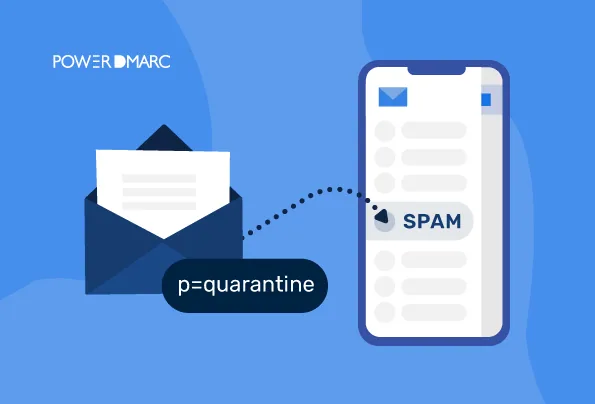
DMARC quarantine (p=quarantine) is the DMARC policy that tells receiving mail servers to deliver messages failing DMARC authentication somewhere other than the inbox. This usually means routing them to the spam or junk folder rather than blocking them outright.
DMARC quarantine is an enforcement policy specified within your domain’s DMARC record. When a sender transmits an email on behalf of your domain, the receiving email server checks the message against your published SPF (Sender Policy Framework) and DKIM (DomainKeys Identified Mail) records. If the email fails these authentication checks and your DMARC policy is set to p=quarantine, the receiver is instructed to treat the email with suspicion.
Instead of rejecting the email completely or delivering it normally to the inbox, the receiver quarantines it. This action protects the recipient from potential phishing or spoofing attempts while still allowing the message to be delivered to a secondary folder.
The execution of a DMARC quarantine policy involves a collaborative process between the sender’s published DNS records and the receiver’s mail transfer agent.
When a DMARC policy instructs a receiver to quarantine an email, the exact destination depends on how the receiving email provider has implemented their procedures. Quarantine is a recommendation, and providers handle it differently.
The functioning of the quarantine policy relies heavily on continuous monitoring and adjustment. When you move to a quarantine state, you must actively analyze the XML reports generated by receivers.
These reports highlight which sending IP addresses are failing authentication. You will likely discover legitimate third-party senders, such as your CRM, marketing platforms, or support ticketing systems, that were improperly configured. The quarantine phase allows you to identify these sources, fix their SPF or DKIM configurations, and verify the changes in subsequent reports without the catastrophic impact of bouncing their emails outright.
The p=quarantine policy acts as a critical safety net. Transitioning directly from a monitoring phase to full enforcement is highly risky. If you have undiscovered legitimate sending sources, a reject policy will cause those important emails to fail without being noticed and disrupt business operations.
Quarantine allows you to test your email authentication posture in a real-world environment. It begins protecting your domain reputation by moving spoofed emails out of the inbox, yet it is forgiving enough that a misconfigured legitimate email can still be retrieved by the recipient if necessary. This builds confidence before making the final leap to reject.
Here are common examples of how a DMARC record with a quarantine policy might look. You can use our DMARC record generator to create these, and our DMARC record checker to validate them once published.
v=DMARC1; p=quarantine; rua=mailto:[email protected];
A standard quarantine policy sending aggregate reports to a specified address.
v=DMARC1; p=quarantine; t=y; rua=mailto:[email protected];
A policy using the new DMARC testing tag (t=y). This tells receivers to treat failing emails as if the policy were one level lower (monitoring only) while you test your setup.
v=DMARC1; p=quarantine; sp=reject; rua=mailto:[email protected];
A policy that applies quarantine to the main domain but rejects failing emails claiming to be from subdomains.
Historically, the pct tag was used to create a staged rollout for enforcement. Instead of applying a policy to all failing emails, domain owners could specify a percentage.
The best practice involved a staged rollout ramp starting with a low percentage, such as pct=10. Administrators would monitor aggregate reports to see the impact. As they gained confidence that legitimate email was passing authentication, they would increase the percentage in stages (for example, to 25, 50, and 75) until they reached 100. Only then would they consider moving to a reject policy. A permanently low pct value leaves a significant portion of spoofed mail unenforced, defeating the purpose of DMARC.
Important Update: The Deprecation of
pctThe DMARC specification has been formally updated with the publication of RFC 9989. Under this new standard, the
pcttag is deprecated. Experience showed the tag was inconsistently implemented by receivers and often used improperly as a permanent safety net. DMARCbis replaces thepcttag with a simpler binary testing tag:t=yfor testing mode ort=nfor enforcement.
t=y: Tells receivers to treat a failing email as if the policy was one level lower. For example, if you publish a quarantine policy witht=y, receivers will treat it as monitoring only. This effectively replaces fractional rollouts.t=n: Instructs the receiver to enforce the policy fully. This is the default behavior if the tag is omitted.If you are setting up DMARC today, you should avoid the
pcttag and prepare for DMARCbis compliance by using the testing tag.
Suggested read: DMARC RFC 9989, 9990, and 9991 Replace RFC 7489
You should implement a quarantine policy only after spending sufficient time analyzing reports while your policy was set to p=none. The signal to move to quarantine is when your reports show that all known, legitimate sending sources are consistently passing DMARC alignment. If you leave your DMARC policy not enabled, you remain vulnerable to spoofing.
Quarantine is the crucial middle step between monitoring and enforcement. You should not, however, park on quarantine indefinitely. The risk of staying on quarantine is that spoofed emails still reach the recipient’s spam folder, where a user might accidentally open them or interact with malicious links.
The signal that you are ready to move from p=quarantine to p=reject is when your quarantine folder rates drop, and aggregate reports show nearly 100% compliance for your authorized senders. Message rejection should be rare for legitimate traffic before making the switch.

The three DMARC policies represent different stages of your email security journey. A policy of p=none is strictly for monitoring your traffic, while p=quarantine provides a middle ground that sends failing emails to the spam folder. The ultimate goal is p=reject, which blocks fraudulent emails before they are delivered.
Suggested read: Learn more about DMARC policies.
What does p=quarantine mean in a DMARC record?
It instructs email receivers to treat emails that fail DMARC authentication with suspicion. Receivers typically handle this by delivering the failing emails to the spam or junk folder rather than the primary inbox.
Where do DMARC-quarantined emails go?
Depending on the receiver, such as Gmail or Yahoo, they usually go to the recipient’s spam or junk folder. In some corporate environments like Microsoft 365, they may go to an administrative Microsoft 365 quarantine portal.
Is DMARC quarantine the same as spam filtering?
No. Spam filtering evaluates the content and sender reputation of an email to guess if it is unwanted. DMARC quarantine is a specific action taken because the email cryptographically failed to prove it was authorized by the domain owner.
Should I use p=quarantine or p=reject?
You should start with quarantine to safely test your configuration. Your ultimate goal should be a reject policy for full protection against spoofing.
What percentage should I set with the pct tag?
Historically, administrators would start at a low number like pct=10 and ramp up to 100. The pct tag is deprecated in the new DMARCbis specification (RFC 9989), and you should transition to using the new testing (t=y) tag instead.
How long should I stay on p=quarantine before moving to reject?
You should stay on quarantine until your aggregate reports consistently show that all legitimate email sources are passing authentication. This typically takes a few weeks to a few months of monitoring and tuning.









 Happyfox DKIM, DMARC, and SPF Setup Guide