DMARC Status of the World’s Top 100 Banks (2026 Research)

by
Last Updated: 9 min read

by
Last Updated: Key Takeaways
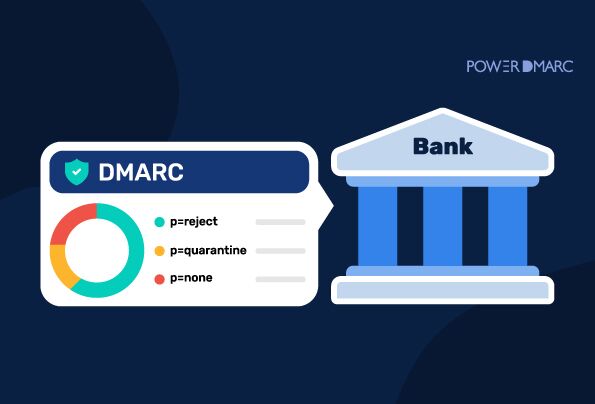
Customers trust the sender name on an email from their bank, which makes bank domains a prime target for spoofing. DMARC lets the owner express a handling preference, but the final handling is always the receiver’s local policy. We checked the DMARC records of the 100 largest banks in the world by assets, using one main customer-facing domain per bank, on 9 November 2026. The headline result: 71 of the 100 enforce DMARC, 13 sit at monitoring-only p=none, and 16 publish no record at all. Below, we break the results down by rank, region, and bank.
Check your own domain: see your DMARC policy in seconds with our free DMARC Record Checker.
We used S&P Global Market Intelligence’s ranking of the world’s largest banks by assets, published on 29 April 2026. Most banks are ranked on total assets as of 31 December 2025, in US dollars. We kept all 100 entries at group or holding-company level, including the two Russian banks (Sberbank and VTB) and institutions with little retail business, such as Goldman Sachs and Norinchukin.
The list covers 24 countries: 21 banks are in mainland China, 12 in the US, 8 in Japan, 6 each in Canada, France and the UK, 5 in South Korea, and 4 each in Australia, Brazil and Germany, with 24 more across 14 other countries. We ranked by assets because it is widely cited and gives a different sample from dmarcian’s revenue-based top 100, so the two studies are not directly comparable.
We checked one domain per bank: the main domain of its primary website in its home market. Where the group brand and the operating bank differ, we used the operating bank’s domain (for example, kbstar.com for KB Kookmin Bank). Where a bank has both home-market and international domains, we used the home-market one (icbc.com.cn rather than icbc.com).
Where the website sits on a subdomain (bk.mufg.jp, jp-bank.japanpost.jp, bank.pingan.com), we queried the subdomain first and then walked up the parent domain hierarchy. This reflects DMARC policy discovery under RFC 9989 (May 2026), which replaced RFC 7489’s reliance on the Public Suffix List with a DNS tree walk using psd= boundary tags to identify where policy and organizational boundaries sit. Note that there is a limit on DNS queries (no more than eight). Names longer than eight labels are shortened to seven before walking. The walk also stops at a record carrying psd=n or psd=y.
We checked alternative domains for six banks as a sensitivity test, and only Japan Post Bank’s fallback to japanpost.jp changes a scored result.
Table 1. Alternative domains checked. Data collected on 9 November 2026.
| Bank | Domain scored (result) | Alternative checked | Alternative result | Effect on dataset |
|---|---|---|---|---|
| ICBC | icbc.com.cn (p=none) | icbc.com (international) | p=quarantine | None; noted |
| Japan Post Bank | jp-bank.japanpost.jp (no record) | japanpost.jp (organizational domain) | p=reject | Scored as p=reject |
| Ping An Bank | bank.pingan.com (no record) | pingan.com (organizational domain) | No record | None |
| KB Financial Group | kbstar.com (no record) | kbfg.com (group) | p=none | None; noted |
| Hana Financial Group | kebhana.com (no record) | hanabank.com | No record | None; noted |
| United Overseas Bank | uob.com.sg (no record) | uobgroup.com (group) | p=reject | None; noted |
For each domain, we ran one DNS TXT lookup for _dmarc.<domain> through Google Public DNS on 9 November 2026, following CNAMEs to the end of the chain (at least 10 banks, including Wells Fargo, ING and Groupe BPCE, publish their record that way). “No record” means NXDOMAIN, no valid TXT record starting with v=DMARC1 at the queried domain or its parent domains along the tree walk.
The main metric is the p= tag: p=reject and p=quarantine count as enforced, p=none as monitoring only. We also noted whether each record has an aggregate report address (rua) and whether the subdomain policy (sp) is weaker than p. No record used pct below 100, so pct changed no classification. We did not score SPF, DKIM, alignment mode, ruf, fo, or ri. Each bank counts once.
Any result can be reproduced with a DNS query for _dmarc.<domain>. Download the full per-bank dataset; our AI-company study uses a similar format.
Of the 100 banks, 84 publish a DMARC record, but only 71 ask receivers to act on failing mail.
Table 2. DMARC policy status of the top 100 banks. Data collected 9 November 2026.
| Status | Banks | Share |
|---|---|---|
| p=reject | 64 | 64% |
| p=quarantine | 7 | 7% |
| p=none | 13 | 13% |
| No DMARC record | 16 | 16% |
| Enforced (reject + quarantine) | 71 | 71% |
Each status means something different for a bank’s customers. Our guide to the DMARC policy options covers them in depth.
Seven of the ten largest banks enforce DMARC on their main domain. ICBC and China Construction Bank are at p=none, and Postal Savings Bank of China publishes no record. ICBC’s international domain, icbc.com, is at p=quarantine, while its home-market domain icbc.com.cn is at p=none. We scored the home-market domain.
Table 3. DMARC status of the 10 largest banks by assets (S&P Global, 2026). Data collected on 9 November 2026.
| Rank | Bank | Country | Domain checked | Status |
|---|---|---|---|---|
| 1 | Industrial and Commercial Bank of China | China | icbc.com.cn | p=none |
| 2 | Agricultural Bank of China | China | abchina.com | p=reject |
| 3 | China Construction Bank | China | ccb.com | p=none |
| 4 | Bank of China | China | boc.cn | p=quarantine |
| 5 | JPMorgan Chase | United States | chase.com | p=reject |
| 6 | Bank of America | United States | bankofamerica.com | p=reject |
| 7 | BNP Paribas | France | bnpparibas.com | p=reject |
| 8 | HSBC | United Kingdom | hsbc.com | p=reject |
| 9 | Crédit Agricole | France | credit-agricole.fr | p=reject |
| 10 | Postal Savings Bank of China | China | psbc.com | No record |
Enforcement varies sharply by region. North America is at 100% and Europe at 94%, while mainland China is at 10% and South Korea at 0%. Excluding mainland China, 69 of the remaining 79 banks (87%) enforce DMARC, and mainland China accounts for 13 of the 16 missing records. All 6 UK banks and all 4 Australian banks are at p=reject.
Table 4. DMARC status by region. Data collected 9 November 2026.
| Region | Banks | Reject | Quarantine | None | No record | Enforced |
|---|---|---|---|---|---|---|
| North America (US 12, Canada 6) | 18 | 18 | 0 | 0 | 0 | 18 (100%) |
| Europe (incl. UK, Switzerland, Russia) | 33 | 28 | 3 | 2 | 0 | 31 (94%) |
| Mainland China | 21 | 1 | 1 | 6 | 13 | 2 (10%) |
| Japan | 8 | 6 | 0 | 2 | 0 | 6 (75%) |
| South Korea | 5 | 0 | 0 | 3 | 2 | 0 (0%) |
| Other Asia-Pacific (Australia, India, Singapore) | 9 | 7 | 1 | 0 | 1 | 8 (89%) |
| Latin America (Brazil) | 4 | 3 | 1 | 0 | 0 | 4 (100%) |
| Middle East (UAE, Qatar) | 2 | 1 | 1 | 0 | 0 | 2 (100%) |
All 18 North American banks, 12 from the US and 6 from Canada, publish p=reject. The only nuance is TD, which pairs p=reject with a weaker subdomain policy of sp=quarantine. For the wider national picture, see our US and Canada DMARC adoption reports.
Of 33 European banks, 28 are at p=reject, 3 at p=quarantine, and 2 at p=none, and none lacks a record. The two monitoring-only banks are La Banque Postale and DZ Bank. Crédit Mutuel uses p=quarantine but sets sp=none for its subdomains. Note that it differs from the RFC 9989 definition and that sp=none leaves existing subdomains unenforced. All six UK banks are at p=reject. For country-level data, see our UK, France and Finland reports.
Mainland China accounts for 13 of the 16 banks with no record. Of its 21 banks, 13 publish no record, 6 are at p=none, one (Bank of China) is at p=quarantine, and one (Agricultural Bank of China) is at p=reject. Only 2 of 21 enforce. These figures show what banks publish, not how mailbox providers treat it.
Six of Japan’s 8 banks enforce DMARC. Mitsubishi UFJ Financial Group (bk.mufg.jp) and Norinchukin Bank are at p=none. japanpost.jp has no weaker sp, or score from sp.
None of South Korea’s 5 banks enforce. KB Financial Group (kbstar.com) and Hana Financial Group (kebhana.com) publish no record, while Shinhan, NongHyup and Woori are at p=none. KB’s group domain, kbfg.com, is also at p=none.
Of the 9 other Asia-Pacific banks, all 4 Australian banks and both Indian banks are at p=reject. Singapore’s three banks are split: DBS is at p=reject, UOB’s main domain uob.com.sg has no record, and the third is at p=quarantine. UOB’s group domain, uobgroup.com, is at p=reject, so the domain choice matters for that one result.
All 4 Brazilian banks enforce (3 at p=reject, 1 at p=quarantine). In the Middle East, First Abu Dhabi Bank is at p=reject and QNB at p=quarantine.
Two secondary checks show gaps in a few records.
No aggregate report address (rua). Three records omit rua (which is optional under RFC 9989/9990). While non-sending or defensive domains sometimes omit rua intentionally to avoid processing report volume, omitting it on an active domain at p=reject (such as DBS) sacrifices visibility into authentication failures and shadow IT. For MUFG (bk.mufg.jp) and Bank of Beijing, pairing p=none with no rua (or ruf) means the record neither enforces policy nor collects monitoring data.
Subdomain policy is weaker than the main policy. TD publishes p=reject with sp=quarantine, and Crédit Mutuel publishes p=quarantine with sp=none. The sp tag sets the default policy for existing subdomains that do not publish their own DMARC record, while RFC 9989’s np tag specifically governs non-existent subdomains (falling back to np, then sp, then p). While a weaker sp leaves active subdomains less protected against spoofing, organizations sometimes use it intentionally as a transitional measure for decentralized departmental subdomains, ideally pairing it with np=reject to block fabricated subdomains.
Of the 100 banks, 29 either monitor only (13 at p=none) or publish no record (16). The table lists them in S&P rank order and reflects the main domain on 9 November 2026. Unfortunately, many of these banks do not enforce DMARC, but may protect other domains differently.
Table 5. Banks without DMARC enforcement. Data collected on 9 November 2026.
| Rank | Bank | Country | Domain checked | Status | Note |
|---|---|---|---|---|---|
| 1 | Industrial and Commercial Bank of China | China | icbc.com.cn | p=none | icbc.com: p=quarantine |
| 3 | China Construction Bank | China | ccb.com | p=none | |
| 10 | Postal Savings Bank of China | China | psbc.com | No record | |
| 11 | Mitsubishi UFJ Financial Group | Japan | bk.mufg.jp | p=none | No rua |
| 14 | Bank of Communications | China | bankcomm.com | No record | |
| 20 | China Merchants Bank | China | cmbchina.com | p=none | |
| 26 | Industrial Bank | China | cib.com.cn | No record | |
| 29 | China Citic Bank | China | citicbank.com | No record | |
| 31 | Shanghai Pudong Development Bank | China | spdb.com.cn | No record | |
| 36 | China Minsheng Banking | China | cmbc.com.cn | No record | |
| 39 | China Everbright Bank | China | cebbank.com | p=none | |
| 48 | La Banque Postale | France | labanquepostale.fr | p=none | |
| 49 | Ping An Bank | China | bank.pingan.com | No record | pingan.com: no record |
| 52 | DZ Bank | Germany | dzbank.de | p=none | |
| 60 | Bank of Jiangsu | China | jsbchina.cn | No record | |
| 61 | Bank of Beijing | China | bankofbeijing.com.cn | p=none | No rua |
| 62 | Hua Xia Bank | China | hxb.com.cn | No record | |
| 67 | KB Financial Group | South Korea | kbstar.com | No record | kbfg.com: p=none |
| 69 | Shinhan Financial Group | South Korea | shinhan.com | p=none | |
| 70 | Norinchukin Bank | Japan | nochubank.or.jp | p=none | |
| 73 | Bank of Ningbo | China | nbcb.com.cn | No record | |
| 75 | China Guangfa Bank | China | cgbchina.com.cn | p=none | |
| 79 | China Zheshang Bank | China | czbank.com | No record | |
| 82 | Bank of Shanghai | China | bosc.cn | No record | |
| 85 | Hana Financial Group | South Korea | kebhana.com | No record | hanabank.com: no record |
| 89 | United Overseas Bank | Singapore | uob.com.sg | No record | uobgroup.com: p=reject |
| 90 | Bank of Nanjing | China | njcb.com.cn | No record | |
| 92 | NongHyup Financial Group | South Korea | nonghyup.com | p=none | |
| 93 | Woori Financial Group | South Korea | wooribank.com | p=none |
Without enforcement, anyone can send email that appears to come from a bank’s exact domain, aimed at customers, partners, and staff. At p=none, the owner receives reports but asks receivers to take no action, so monitoring-only is a stage, not a destination.
Major mailbox providers set a baseline for inbox deliverability rather than full spoofing protection: Google and Yahoo (since 2024) and Microsoft Outlook.com (since May 2025) require high-volume bulk senders (defined by Google and Microsoft as >5,000 messages/day) to have both SPF and DKIM. Google requires both to be set up, Yahoo requires implementing both, and Microsoft says both must pass. Only alignment needs just one. Scope also matters: Google counts mail to personal Gmail accounts per primary domain (“close to 5,000 or more”), and Microsoft’s rules cover Outlook.com consumer domains. Other rules go further in places. PCI DSS v4.0.1 Requirement 5.4.1, mandatory since 31 March 2025, requires automated anti-phishing mechanisms for organizations that handle card data. Its guidance cites DMARC, SPF, and DKIM as example anti-spoofing controls, though the requirement itself does not name DMARC.
PowerDMARC provides DMARC reporting and hosted policy management that support steps 2 to 5. See our page on DMARC for financial institutions.
On 9 November 2026, 71 of the world’s 100 largest banks enforced DMARC on their main domain and 16 published no record at all. The gap is regional: North America and Europe are at or near full enforcement, while 13 of 21 mainland Chinese banks and 2 of 5 South Korean banks publish nothing. Check your own domain with our free domain analyzer, or book a demo to see how PowerDMARC can help you reach p=reject.
On 9 November 2026, 84 of the 100 largest banks by assets published a DMARC record on their main customer-facing domain, and 71 enforced it: 64 at p=reject and 7 at p=quarantine. Another 13 were at monitoring-only p=none, and 16 published no record at all.
At p=reject, the domain owner requests that receiving mail servers block messages that fail DMARC authentication (typically by rejecting them during the SMTP transaction, though receivers retain discretion over local filtering). It protects the exact domain from direct spoofing, though organizations must ensure their own legitimate senders are properly authenticated beforehand to avoid blocking valid customer communications.
No. At p=none, the domain owner requests reports but asks receivers to take no action on failing mail, so spoofed messages can still be delivered. It is a sensible starting point for visibility, but protection only begins at p=quarantine or, more completely, p=reject.
North America. All 18 North American banks in the list, 12 from the US and 6 from Canada, publish p=reject. Europe follows at 94% enforcement (31 of 33 banks). Latin America and the Middle East also enforce at every bank, but the groups are small, with 4 and 2 banks.
Look up the TXT record at _dmarc.<domain>, using a lookup tool such as our DMARC Record Checker or a standard DNS query. A record starting with v=DMARC1 holds the policy in its p= tag. When a subdomain inherits the organizational domain’s record, its policy comes from sp (existing subdomain) or np (non-existent), and from p only if those are absent.
There is no global law requiring banks to publish DMARC, and requirements vary by country and regulator. Some frameworks point toward it: PCI DSS Requirement 5.4.1 requires anti-phishing controls for card-handling organizations and cites DMARC in its guidance (though doesn’t name it). Check your local regulator’s expectations.

