All You Need to Know about Verified Mark Certificates (VMC) with PowerDMARC

by
Last Updated: 7 min read

by
Last Updated: Key Takeaways
Phishing attacks continue to rise as cybercriminals increasingly impersonate trusted brands in email. To stand out in crowded inboxes and help recipients recognize legitimate messages, organizations need stronger visual trust signals.
This is where BIMI and Verified Mark Certificates come in. BIMI allows brands to display their logo in supported inboxes, while a Verified Mark Certificate (VMC) helps verify that the logo belongs to the authenticated sender.
In this guide, we’ll explain what a verified mark certificate is, how VMC for BIMI works, what requirements you need to meet, and how to implement it correctly.
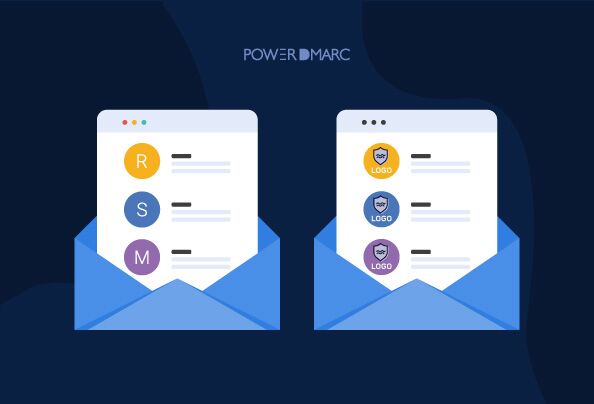
A verified mark certificate (VMC) is a digital credential that certifies your company’s registered trademark and enables your logo to appear next to your email messages in supported email clients.
This visual verification instantly signals trust to every recipient, making impersonation much harder.
VMC for BIMI is a clear indication to your customers that you are a legitimate business, and not a malicious source trying to phish them. a VMC instills trust among your esteemed client base by visually affirming that you’ve gone through a process to verify your identity and the legitimacy of your business.
BIMI (brand indicators for message identification) is an email authentication protocol that allows brands to display their logos in supported inboxes once DMARC enforcement is in place.
VMC (Verified Mark Certificate) is the certificate that verifies a brand’s logo trademark so that BIMI can display a verified logo in certain mailboxes (like gmail).
In simple terms:
How Verified Mark Certificates work with BIMI
Verified Mark Certificates work by validating that a brand owns the trademarked logo it wants to display in supported inboxes. Once the domain has DMARC enforcement in place, the organization can obtain a VMC certificate for BIMI from an approved certificate authority.
The brand then publishes a BIMI DNS record that points to the approved logo file and the VMC. When a supporting mailbox provider receives an authenticated email, it checks the BIMI record and certificate before displaying the verified logo.
While verified mark certificates (VMCs) are the standard option for trademarked brands, some organizations may not yet have a registered trademark for their logo. In such cases, a common mark certificate (CMC) offers an alternative way to display logos through BIMI.
A common mark certificate (CMC) is an alternative to a VMC for organizations that want to display their logo via BIMI but don’t have a registered trademark. Instead, CMCs require proof of logo usage for at least 12 months.
While CMCs do not provide Gmail’s blue checkmark, they can still help brands display logos in many supported inboxes, making them a practical option for growing brands and smaller businesses.
| Feature | VMC (Verified Mark Certificate) | CMC (Common Mark Certificate) |
|---|---|---|
| Trademark Requirement | Registered trademark required | 12+ months proof of logo use |
| Gmail Blue Checkmark | Yes | No |
| Cost | Higher (typically $1,500-$3,000/year) | Lower (typically $500-$1,500/year) |
| Target Audience | Large enterprises, established brands | SMBs, emerging brands, non-profits |
| Logo Display | All supporting mailboxes | Most supporting mailboxes (except Gmail checkmark) |
Before applying for a verified mark certificate (VMC), organizations must meet a few technical and legal requirements to qualify for BIMI logo verification.
Before applying for a VMC, ensure you meet these essential requirements:
VMCs can only be issued by BIMI-approved certificate authorities, including DigiCert, Entrust, and GlobalSign.
Organizations must first meet key email authentication and trademark requirements before configuring BIMI correctly. The good news is that the process is fairly straightforward when broken down into the right steps.
By enforcing DMARC, you also ensure that only authorized emails use your brand, blocking attackers at the source.
To get your VMC, as a prerequisite, you need to:

After getting hold of your verified mark certificate, configure BIMI for your organization to make sure your emails can be visually authenticated, and your selected logos are being displayed by supported mailbox providers.
Note: all providers do not require VMC for BIMI logo display, but many do.
PowerDMARC’s PowerBIMI helps simplify this process by hosting your BIMI record, generating the required DNS record, and making future logo or certificate updates easier to manage.

The benefits of implementing BIMI and VMC are many. For example:
Experience up to 10% higher engagement rate for your email marketing campaigns. Having your verified logo appear on emails sent from your organization is an instant trust indicator that has a much higher impact on receivers.
Reduces risks of spoofing, and phishing significantly by enforcing your DMARC policy. DMARC at p=reject helps block unauthorized emails from being delivered under your domain.
This is particularly useful for multi-logo brands. Multinational companies may have separate logos for separate departments or services. BIMI lets you control the logo you want to be displayed for multiple domains.
Visual differentiation in inboxes is the key to high engagement rates. BIMI, along with VMC, is the perfect tool for enhancing your email marketing efforts and increasing your brand recall.
Verified mark certificates (VMCs) are useful across industries where brand trust, email security, and customer engagement matter. from financial institutions to e-commerce brands, organizations use VMCs to strengthen visual identity in inboxes while reducing the risk of impersonation and phishing attacks.
Large corporations use VMCs to ensure their marketing emails stand out in crowded inboxes, with verified logos building immediate trust and improving click-through rates.
Banks and financial institutions can use VMCs to make legitimate emails more recognizable and reduce the risk of phishing campaigns that impersonate their brand.
Healthcare organizations can use VMCs and BIMI to make legitimate patient communications easier to recognize, while DMARC enforcement helps reduce the risk of domain impersonation.
Online retailers implement VMCs to protect their brand from impersonation and ensure customers can easily identify legitimate order confirmations and promotional emails.
As inbox providers continue prioritizing authenticated and trustworthy email, implementing VMC and BIMI is quickly becoming a competitive advantage for modern brands. Here’s a quick recap and what to do next.
As phishing and domain impersonation attacks continue to rise, displaying a verified logo in the inbox is becoming more than a branding advantage, it is quickly turning into a trust signal customers expect. Verified Mark Certificates (VMCs) and BIMI help organizations combine stronger email authentication with recognizable brand visibility, improving both security and engagement.
For organizations managing multiple domains, enforcing DMARC compliance and deploying BIMI at scale can become operationally complex. PowerDMARC simplifies the process with automated compliance checks, centralized domain visibility, guided VMC onboarding, and expert support for enterprises and MSPs. Whether your goal is improving email deliverability, protecting your brand from impersonation, or increasing customer trust, implementing VMCs and BIMI is a practical next step toward a more secure outbound email strategy.
To get a VMC, you need: 1) a registered trademark for your logo, 2) DMARC enforcement (p=quarantine or p=reject), 3) logo in svg p/s format, and 4) purchase from an approved certificate authority like digicert, entrust, or globalsign.
VMC requirements include: registered trademark, DMARC policy at enforcement level, svg tiny p/s logo format, domain ownership verification, and organization validation documents.
VMC costs typically range from $1,500 to $3,000 per year, depending on the certificate authority and validation level. this includes trademark verification and ongoing certificate maintenance.
VMCs require registered trademarks and enable gmail’s blue checkmark, while CMCs only need 12+ months of logo usage proof and don’t provide the gmail verification badge. VMCs are more expensive but offer stronger brand protection.
According to the BIMI group, supporting providers include gmail, apple mail, yahoo mail, fastmail, comcast, la poste, zoho mail, and others. gmail requires VMC for the blue checkmark verification.
One VMC can cover multiple domains if you use the same logo; you only need additional VMCs if you want to display different logos for those domains
Register your logo as a trademark with your national or regional intellectual property office (e.g., uspto, euipo), which legally establishes your ownership. this is a requirement for a VMC.
You can convert your BIMI logo to svg tiny p/s manually using adobe creative tools, or you can use powerDMARC’s BIMI svg logo converter for instant results.
According to the BIMI group, apple mail, comcast, google, cloudmark, fastmail, la poste, docomo, onet, yahoo mail, zoho mail, zone, zoner, and gmx currently support BIMI.


 What is Credential Phishing and how does DMARC prevent it?